First I should say, following yesterday's post, I received a nice update this morning about my aunt. According to her brother, Unce Martin, she's had a good sleep and is now eating and "(as the school reports used to say) ‘showing improvement’", which is fantastic. My mother's side of the family are juggernauts.
I didn't head out this afternoon expecting surprises, although there are still streets in NW1 I haven't yet walked down and courtyards to chance upon. I just wondered how empty they'd be. Most people I passed were wearing masks, which had become rare outdoors, but they do keep your face warm. I thought of a new translation to the first line of The Odyssey: "Let's have a story about a windy man!" But how would the reader know which pronunciation of "windy" was meant? That's the only problem.
Things were a lot quieter than in Defoe's day I think. I was coughing quite a bit, but I've now come to recognise this epiglottal build-up of fizzy pizza-flavoured throat-pop: it took me five Christmases to realise it doesn't mean I have food poisoning, I'm just wearing my belt too tight. And I don't have to have eaten pizza to taste it. I forgot that only one of the spires of Saint Paul's has a clock in it, like the eyes of a broken robot pirate. Here's a statue I like. Look at them shimmy.
I missed the hose on the other side. Another reason I like this, I suppose, is because it's a statue of a team. A lot of people get heroism arse backward. Odysseus might be to blame for this, but its root isn't the journey of the indivual. Human beings evolved as a team. That's why we have language. We hunted as a
team, gathered and ate as a team, and sitting round the fire is how we
managed to stay warm enough to spread across a planet. Only once we'd
got the hang of this, I think, could we find ways to be alone. Solitude isn't getting back to nature, it's a benefit of civilization, and I hope, now that another lockdown's been announced, you can still find it if you want it, or still enjoy it if you've now no choice.
Helen, whose abduction famously precipitated the Trojan War, was one of two daughters born to the mortal Leda after Zeus came onto her in the form of a swan, a heritage subtly alluded to by the feathers round Helen's neck in the above still from Troy: Fall of a City, and less subtly alluded to in this illustration from Larry Gonick's far less trashy Cartoon History of the Universe:
One thing I didn't know about Helen though, until I read the Odyssey, was that she had known all along about the Greeks' plans to conquer her adopted city with an army hidden in a huge wooden horse. According to her account to Odysseus' son Telemachus a decade later, she had bumped into Odysseus when he sneaked into Troy disguised as a beggar, immediately recognised him, gave him a
bath and then, somehow, managed to get him
to tell her the whole plan. But then she let him go and didn't tell anyone because
she was sick of this now ten-year-long siege and just wanted to be taken back to Greece. Wait, I thought, why had I not heard his before? Was this the normal story? If this was the case, why didn't Helen just sneak out of Troy
with Odysseus and end the war there? Happily I was able to ask Natalie Haynes all this, and here is Natalie's reply:
"Ten
points for reading the Odyssey, but you lose a point for thinking
there is any such thing as the normal story. So, net gain: nine
points... The version of Helen in the Odyssey does say/do that (there is
a much madder bit, at least to my eyes, in some versions where, when
the Trojan Horse is found and the Greek soldiers are suspected of being
inside, Helen does a sort of Mike Yarwood thing and impersonates the
voices of the wives of the Greeks. She's so convincing she reduces
several horse occupants to tears... HOW MAD IS THAT?) I think the
important thing to bear in mind with Helen is that you can't necessarily
believe what she says – I think she probably did want to go back to
Greece, but the insult of her kidnap/abduction/adultery wouldn't be
removed if she just snuck off with Odysseus – the Greeks would still
want revenge on Paris and they'd still want to loot Troy, which is the
only reason a lot of them are there... So she might as well wait it out
in the city than in the Greek camp. But that's just my reading... Also,
Homer's Helen is a real plaything of the gods, esp Aphrodite, so she may
not have had the option of bailing with Odysseus – Aphrodite threatens
her quite pointedly in Iliad 3, when she says she's not that into Paris
anymore..."
So there you go! I now need to find out exactly what Helen did that made Odysseus talk. Might it have been her Mike Yarwood bit? If you have any mythology-based questions of your own, you can ask Natalie here.
How many things can YOU name that have nothing to do with either horses or Troy?
I've finally started reading The Odyssey, in the translation by Emily Wilson that I was hearing such great things about, and it's terribly good. I haven't met the Cyclops yet. I'm only on Book Five, so I haven't even met Odysseus, but I'm also glancing at the eighteenth-century translation by Alexander Pope to compare accounts, and I feel you're missing out if you've only read Pope. He makes no mention, for example, of Calypso’s island being covered in celery.
Another account I'd like to draw readers' attention to however – in addition to the three film adaptations mentioned back in October - is this hour-long radio Odyssey penned by my landlord David Reed for his gang "The Penny
Dreadfuls", all of whose comedies have now been put online for ever, it seems. In allowing himself to dwell on the more absurd qualities of Odysseus'
heroism, David's adaptation unwittingly, but beautifully, illustrates
not only the many niggling questions Natalie Haynes would later let Odysseus'
wife Penelope voice in A Thousand Ships, but also Emily Wilson's reasons for working on her own translation. Robert Webb plays Odysseus in this one, and Elpenor - the crew member he meets as a ghost in Hades whom he hadn't even realised was dead - sounds pleasingly like Jim Howick's Pat from Ghosts. Finely focused comic adaptations rather than spoofs – although they spoof the clichés of adaptation very well – I recommend the whole "Penny Dreadfuls" oeuvre. They might make you cleverer. They make me miss writing.
Basically, what these depictions of the blinding of Polyphemus prove is that it's hard to paint a cyclops from the side. Representing the physical world in two dimensions, like impersonating Christopher Walken, is something we can only to do it once we've seen how someone else does it, and at the time these vases were painted, 27 hundred odd years ago, clearly nobody had yet drawn someone from the front. I'd love to know what anxiety, if any, was felt by the artists who had to depict a famously one-eyed creature under these restrictions. Once the first Cyclops had been attempted, was the heat off, the precedent set? I can't find out which of these vases was the first though, nor whether the artists had seen each other's work, or simply decided independently to stop bothering.
Gorgons were painted face on! And they date from as far back as the vases! So artists did know how to paint a face from the front. But only if it belonged to a gorgon? How did that work? And is this actually a face seen from the front? Or is it...? Let me just cover up one half with my hand... Is it just two profiles stuck together?
I wonder if the ancient Greeks had fun making these with a mirror.
That was meant to be the staff of the Jerymyn Street Theatre up there in place of the blue. I don't know what went wrong, but huge thanks to them for trying so hard to sort it out, and also to whoever had to step in for me at the last minute. On a more positive note, at least l was introduced to the work of Emily Wilson, even if I never got to perform it. And if you want a similarly happy introduction...
The sob story related to Odysseus in Hades by the ghost of Agamemnon that I was meant to perform is most famously dramatised in three two-and-a-half-thousand-year-old tragedies by Aeschylus collectively known as the Oresteia, named after Orestes, the son of Agamemnon who in the final play is pursued by Furies after murdering his mother after she murdered his father after he murdered their daughter. In that cycle the whole mess is eventually cleared up by a Divine Court who rule that, no matter who started it, they're stopping it, and that it should now be "the citizens", and not snake-haired anthropormorphic guilt demons, who decide matters of law, thereby creating the model for the contemporary Athenian city-state. Great! Except!... as Wilson observes beautifully in this review for the LRB of three (THREE!) new translations of The Oresetia, at that time neither mothers nor daughters were "citizens" of Athens, presenting women as very much part of the problem, a nuance none of the male translators Wilson reviews bothers to address.
She talks more about both this and her translation of The Odyssey on the LRP podcast here, while Charlotte Higgins' great review of the latter in The Guardian had me immediately buying it online, resolved that this would be the translation I'd finally read: Higgins notes for example that Wilson translates kunopis – a rare word with canine connotations once used by Euripides to describe the Furies – as "the face that hounded", whereas earlier translations provided by Wilson's male predecessors settled for the less ingenious "whore" or "bitch". You know. Nuance.
So again, I'm very sorry not to have been able to perform her words, and really have no idea what went wrong. A weak signal? I had back-up device after back-up device open though, just in case, oh wait, maybe that was the problem.
The Jermyn Street Theatre and London Review of Books' online reading of Emily Wilson's superb translation of The Odyssey is tomorrow. (Today? Friday anyway.) Kicking off at nine in the morning, seventy-one actors - including me at around four in the afternoon - will have the impossible job of following Janet Suzman, but if twelve hours is too long an Odyssey for you don't worry, I've looked out some shorter ones. You can watch Hallmark's three-hour mini-series starring Armand "Rico Dredd" Assante, for example, HERE.
Michael J. Pollard plays a Wind God, and ten minutes in Heathcote Williams is attacked by a giant eel so it's an odd watch, I won't lie, while Armand Assante... I mean I love him, but he's about as complicated as a tap. You haven't come to a film of The Odyssey for the complications though, so if you can't spare three hours why not instead check out THIS? Recommended by David Cairns (again), the almost completely unknown 1954 Italian adaptation stars Kirk Douglas and comes in at just under a hundred minutes.
Still too long? That's alright, I haven't seen it yet either. Don't go anywhere. Last one: Shot on the original camera of the Brothers Lumières to celebrate a hundred years of cinema, Greek auteur Theodoros Angelopoulos' 1995 adaptation of Homer's Odyssey runs to just fifty-seven seconds...
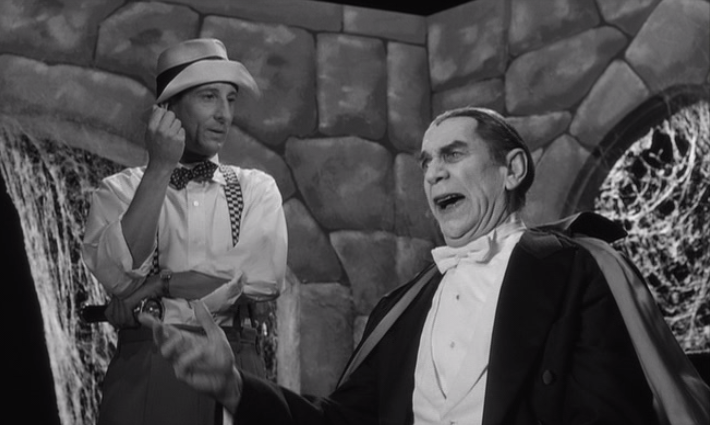
As a final Frankenstein Wednesdays postlude, here is one of Bela Lugosi and Lon Chaney Junior's last appearances together (and Lugosi's frist appearance with Vampira, five years before Plan 9 For Outer Space) a shabby sketch show starring a shabby comedian sponsored by something called Geritol. I've only stuck it here to dispel the myth that Lugosi's one foray into live television was a total disaster, and that Red Skelton's improvisations caused him to jeopardise the show because as you can see, that's not what happens at all. Bela forgets a line, but that's it. It's fine. It's even charming. Live theatre was Bela's livelihood, and I know he looks shockingly ill, even standing next to Chaney who looks like Bill the Cat, but it still makes me happy to see him doing work this good with material this bad (including his own mortal tissue). It's nothing like the scene in Ed Wood, is what I am saying. The curtain's not brought down.
I love this movie. But.
Moving on though: What am I going to do for Wednesdays now? I know I didn't aways make the deadlines, and that last Abbott and Costello post went on for eight days, so maybe I should give myself a break and not dedicate Wednesdays to anything for a while. But if I were to, here are some candidates...
Clockwise, from top left:
A box set of the first six Star Trek films: in which the original crew of the Enterprise grow old and realise they've nothing but each other. In trying to wring adventure out of Reason rather than Romance Trek's impact on popular science fiction, and by extension the popular subconscious, might be as deep as Frankenstein's. But do I really want to chunter on in that vein for six weeks? Conventional wisdom says the odd-numbered films are bad and the even-numbered ones are good, so at least I'd be kept on my toes. Or if I wanted to stay in the thirties...
A box set of seventeen W. C Fields Features: I adore W.C. Fields, am always happy to recommend his work, and know there are at least five films in here I'd want to say something about. Also this would let me delve deeper into the thirties, nor do I remember any of them being stinkers. Still five out of seventeen's not a great ratio, and maybe I should be careful how much of the thirties I dabble in. There's always earlier...
A box set of Early Hitchcock. Nine films, all British, some silent. There's a lot here I haven't seen, so that would be one reason to go for this. And I love Hitchcock's early British stuff. But maybe too niche. Maybe I could review some telly instead...
A box set of the Bardathon. Clive James' name for the BBC's televising of every single play known to have been penned by Shakespeare at the time of broadcast, the early eighties. Thirty-nine plays, each about three hours long. So a hell of a project, but I have already watched them all, and enjoyed most of them. Then again, I'm an English graduate. Also I've no idea what these posts would look like. A bit curious to find out. Also piquing my curiosity...
Twenty-two Ingmar Bergman films I inherited from my godfather. Again, a very heavy exercise. I've seen very little Bergman though, so like the Hitchcock this would be an excuse to finally watch something, rather than an opportunity for closer study. And Bergman definitely deserves closer study. And maybe now's not the time. Or maybe he's completely up my alley. I've no idea, this is the biggest blind spot on the current list. Unlike...
The complete Ulysses 31. Space. Robots. God. Bad acting. Good design. Great music. Twenty-six episodes. Last-minute thought. I still haven't read the Odyssey. Back to the thirties...
The Complete Thin Man Collection. William Powell and Myrna Loy get pissed and solve crimes in the thirties. Six films. I love the first two - maybe too much to have anything interesting to say about them - and I haven't seen the last four. Speaking of Powells...
Two box sets of films by Powell and Pressburger. Some absoute wonders here, but I haven't seen them all, so again I'd be using this as an opportunity to cath up. A lot has already been written about the films I have seen though, and I'm not sure I'll be bringing much to this party. And finally...
The complete Basil Rathbone and Nigel Bruce Sherlock Holmes. Fourteen films, which I love, which is a reason for choosing them. Also I'm not sure I've seen them all, which is another reason for. Also there'll be some continuity of talent with Universal's Frankensteins, another reason for. But I might love every film for the same reason, and there's fourteen of them, so I might not have that much new to say about each. Then again, maybe "not that much" is eactly the right length for a blog.
Okay, just searching for those screengrabs has made me keen to do definitely something. Feel free to make suggestions below.