Further to last night's Question One, I really enjoyed Big Faced Frank Finlay's first appearance as Van Helsing here in this BBC adaptation from 1977, (which is hopefully where this video starts). His bedside manner's very convincing. He feels like an actual doctor, which makes the vampirism all the more convincing as a disease. There's a lot I liked about this adaptation, which I came to via this piece in The Chiseler praising the focus given to Judi Bowker's Mina (and I bet you money Mel Brooks watched it). As the Count, Louis Jordan gives the impression that he at least thinks he was perfectly cast, which might be all one needs, it's certainly all he needs, and the cutting-edge, nineteen-seventies video effects used sparely, but unahsamedly, to signal Dracula's reality-fracturing otherness is a pretty good match for the proto-modernist surrealism of Stoker's book. The only real problem is its fidelity to the source, a problem no adaptation I've seen has managed to solve. Cure's aren't thrilling. So the opening's superb - staying at Dracula's castle is a hard episode to get wrong - and the fall of Lucy is similarly gripping - there's no obvious nod to The Exorcist, but attention has clearly been paid - but once Lucy's "saved" there's no escaping the fact the climax is a band of heroes who all get on chasing, basically, just a box, accompanied by a heroine who needs to lie down a lot, which is hardly Jaws.
Shame if something... happened to it." Count Dracula
And I haven't seen the final episode of the latest BBC Dracula yet, but given that the first two roll out the usual Gatiss/Moffat triumph-of-the-will pissing contest between intellectual bullies whose every move is nevertheless either two steps behind the audience or too stupid to have been entertained, I'm not gagging for more. I mean, I'm honestly sure Mark Gatiss is a properly lovely man, but everything he writes suggests someone who loves the past without being remotely interested in history, and it's hard not to feel right now that that's making the world shitter.
As a final Frankenstein Wednesdays postlude, here is one of Bela Lugosi and Lon Chaney Junior's last appearances together (and Lugosi's frist appearance with Vampira, five years before Plan 9 For Outer Space) a shabby sketch show starring a shabby comedian sponsored by something called Geritol. I've only stuck it here to dispel the myth that Lugosi's one foray into live television was a total disaster, and that Red Skelton's improvisations caused him to jeopardise the show because as you can see, that's not what happens at all. Bela forgets a line, but that's it. It's fine. It's even charming. Live theatre was Bela's livelihood, and I know he looks shockingly ill, even standing next to Chaney who looks like Bill the Cat, but it still makes me happy to see him doing work this good with material this bad (including his own mortal tissue). It's nothing like the scene in Ed Wood, is what I am saying. The curtain's not brought down.
I love this movie. But.
Moving on though: What am I going to do for Wednesdays now? I know I didn't aways make the deadlines, and that last Abbott and Costello post went on for eight days, so maybe I should give myself a break and not dedicate Wednesdays to anything for a while. But if I were to, here are some candidates...
Clockwise, from top left:
A box set of the first six Star Trek films: in which the original crew of the Enterprise grow old and realise they've nothing but each other. In trying to wring adventure out of Reason rather than Romance Trek's impact on popular science fiction, and by extension the popular subconscious, might be as deep as Frankenstein's. But do I really want to chunter on in that vein for six weeks? Conventional wisdom says the odd-numbered films are bad and the even-numbered ones are good, so at least I'd be kept on my toes. Or if I wanted to stay in the thirties...
A box set of seventeen W. C Fields Features: I adore W.C. Fields, am always happy to recommend his work, and know there are at least five films in here I'd want to say something about. Also this would let me delve deeper into the thirties, nor do I remember any of them being stinkers. Still five out of seventeen's not a great ratio, and maybe I should be careful how much of the thirties I dabble in. There's always earlier...
A box set of Early Hitchcock. Nine films, all British, some silent. There's a lot here I haven't seen, so that would be one reason to go for this. And I love Hitchcock's early British stuff. But maybe too niche. Maybe I could review some telly instead...
A box set of the Bardathon. Clive James' name for the BBC's televising of every single play known to have been penned by Shakespeare at the time of broadcast, the early eighties. Thirty-nine plays, each about three hours long. So a hell of a project, but I have already watched them all, and enjoyed most of them. Then again, I'm an English graduate. Also I've no idea what these posts would look like. A bit curious to find out. Also piquing my curiosity...
Twenty-two Ingmar Bergman films I inherited from my godfather. Again, a very heavy exercise. I've seen very little Bergman though, so like the Hitchcock this would be an excuse to finally watch something, rather than an opportunity for closer study. And Bergman definitely deserves closer study. And maybe now's not the time. Or maybe he's completely up my alley. I've no idea, this is the biggest blind spot on the current list. Unlike...
The complete Ulysses 31. Space. Robots. God. Bad acting. Good design. Great music. Twenty-six episodes. Last-minute thought. I still haven't read the Odyssey. Back to the thirties...
The Complete Thin Man Collection. William Powell and Myrna Loy get pissed and solve crimes in the thirties. Six films. I love the first two - maybe too much to have anything interesting to say about them - and I haven't seen the last four. Speaking of Powells...
Two box sets of films by Powell and Pressburger. Some absoute wonders here, but I haven't seen them all, so again I'd be using this as an opportunity to cath up. A lot has already been written about the films I have seen though, and I'm not sure I'll be bringing much to this party. And finally...
The complete Basil Rathbone and Nigel Bruce Sherlock Holmes. Fourteen films, which I love, which is a reason for choosing them. Also I'm not sure I've seen them all, which is another reason for. Also there'll be some continuity of talent with Universal's Frankensteins, another reason for. But I might love every film for the same reason, and there's fourteen of them, so I might not have that much new to say about each. Then again, maybe "not that much" is eactly the right length for a blog.
Okay, just searching for those screengrabs has made me keen to do definitely something. Feel free to make suggestions below.
The huge success of "Abbbott and Costello Meet Frankenstein" meant numerous, lazier horror sequels for Bud and Lou, but none for Frankenstein's Monster, Dracula or the Wolf Man, so let's
say some goodbyes... Firstly, Glenn Strange: Of all the
Monsters we've seen over the past two months, his was by far the most reliably unconscious, but in this last outing we finally see him give lumbering chase, closing in like a moving wall, the perfect nightmare
somnambulist. Many commentators express disappointment, given the Monster's historic fear of flames, that he ends this film walking directly into a fire, but I like the look of pained surprise on his face as he does so, like a
sleepwalker suddenly waking. The fire's properly explained this time too. The
Monster's lost, his master gone, there's water beneath him and he's
done this before, he knows the deal now, so no, I'm fine with
"Junior" finally giving himself to the flames, and I remember watching his death as a child with a weird feeling of horror and pity new to me. Speaking
of which...
Oh, Bela! My happiest takeaway from these Wednesdays has been finding out just
how good an actor he was. It's said his manager
had to literally shame Universal
International's new bosses into recasting the now sixty-five-year-old Lugosi as Dracula, the oldest actor to play him until
John Carradine would return to the role in 1979. "You owe Bela this" his manager said apparently. They thought he was dead, it is said. That's Lugosi's myth anyway, and it's the Bela of Ed Wood,
and it's why I'm so reluctant to dwell on the lives of the artists on this blog,
because it shouldn't be necessary to pity Lugosi in order to love him. He doesn't need "points for trying", although God knows he earnt them. Five years earlier, he'd been slumming it as a heavy, opposite
Monogram Pictures' super-numerary East Side Kids in William "One-Take"
Beaudine's Ghosts on the Loose, so maintaining dignity in the
face of packaged zaniness was not a new trick for him, but here, allowed to be in on the joke again as he had been in Son of Frankenstein, and allowed to be Dracula again (this was actually only the second time he had played the Count on screen) Lugosi balances both tasks to achieve what I so loved Boris Karloff for achieving in Frankenstein: a performance no other actor would have known how to give. Actual magic.
I've written a little before about why I think this is Lon Chaney Junior's best Wolf Man too: he's on a
mission here, and he's noone's creepy love interest. That said, he does in this film sometimes get relegated to the status of guy-in-a-gorilla-suit, and his games of "behind you"
with Costello's Wilbur make very little sense. However, when there's a barrier between
them – a hotel wall or a transatlantic call – he's immediately thrilling in a way I haven't seen before. Putting a werewolf behind a door you shouldn't open clearly provides more interesting
nightmares than pouncing from the shadows.
I also said this film was the work of perfectionists. Well, here are some numbers: According to Gregory W. Mank's detailed Blu-ray commentary, Lon Chaney Jr. had to lie still for a day and a half while makeup job after makeup job was applied to his face for the opening transformation, after which the team decided they could still do better, and spent a second full day re-doing the whole thing. (These stage-by-stage transformations always fascinated me as a child – as is evident in this comic from 1987 – but the fact Talbot had to remain completely still for them was always a problem, only successfully addressed when it first happened in The Wolf Man and Talbot was already supposed to be dead.)
Awwwww!
Despite his exemplary behaviour on set, lying still for two and half days, or stepping in as the Monster when Glenn Strange had twisted his ankle, Chaney also apparently hated this film, retrospectively blaming itfor the change in Horror's tone towards self-parody in the second half of the twentieth century, which possibly mistakes the symptom for the cause, and is a huge shame. I don't know what the actual cause was, but off the top of my head, I'd suggest the more a culture identifies as middle-class, the more comfortably it favours for catharsis customers shouting at a comedian over torch-wielding mobs storming a castle. The Titus Andronicus Project's youtube commentary talks a lot about Chaney's unhappiness, but it also provides a beautiful coda to the series by noting that the last voice we hear in the film, that of the Invisible Man (great joke), belongs to an actor who would come to exemplify this lighter-hearted attitude towards the Gothic. The last laugh, literally, belongs to Vincent Price.
Having begun this project moaning about the lack of music in "Dracula", here to play us out is Frank Skinner's terrific "Abbott and Costello Meet Frankenstein" suite.
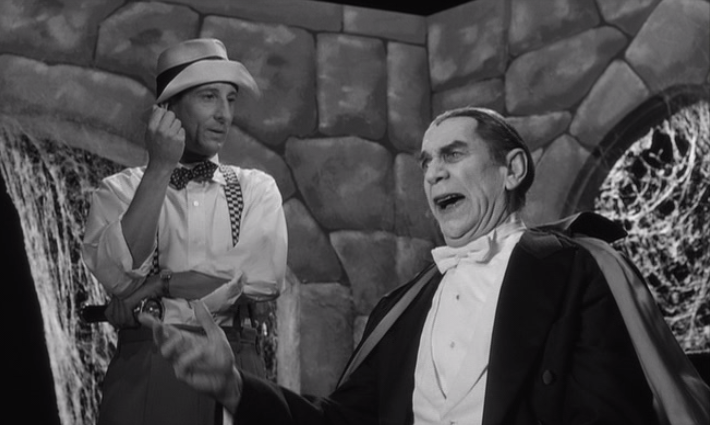
If Bela Lugosi's Dracula in "Abbott and Costello Meet Frankenstein" is better than his Dracula in "Dracula", some thanks must go to co-star Lenore Aubert. A fellow Hungarian refugee (Lugosi fled the country in 1919 after a failed Communist revolution, Aubert fled the Nazis twenty years later) she plays Universal's first female Mad Scientist: Unspecified "curious experiments" have exiled Dr. Sandra Mornay to a castle off the coast of Florida, where Dracula has blackmailed her into finding a more dependably pliable brain to put inside his Frankenstein's Monster. Enter Abbott and Costello. When we're first introduced to Mornay, as Costello's "classy dish" tenderly nursing his head injury from fallen luggage, there's no indication she'll be anything other than the schlubby comic's typically glamorous love interest. The affection she showers upon Costello's Wilbur is entirely credible, as is everything else Aubert will do in every scene she's in.Look at the shot below, for example. Remove Aubert from the image... cover her up with your fingers or something...
Brawn, Brains and Madness. The Baddie Triumvirate.
Now put her back in... See? It's impossible for a scene to be dumb when she's present.
It's also far more engaging to watch Dracula trying to charm an equal rather
than seduce an innocent, and when their differences are finally aired, and he goes in for the kill, I think Aubert might be the first ever victim to smile onscreen when bitten. It's hard to say who out of Lugosi and Costello is the greater benificiary of her provision of reality, but both up their game. Lou, despite his ego, would never be as loveable as he is as Mornay's puppy, just as Bela, despite his frailty, would never be as imposing as he is as Mornay's blackmailer. Lou and Bela also complement each other superbly, but once you get beyond
the scare takes and the mesmerism, it's Aubert who is the chemist behind
this chemistry. She doesn't have much to do in the following clip, for example, but it's her they're playing to (discuss)...
This is the clip I'm posting for International Women's Day? This.
The short-sleeved stud at the end, by the way, is Charle Bradstreet as Doctor Stevens, Mornay's glamorous assistant, whom she definitely didn't hire for his smarts. To be continued...
How often is the last film in a series the one you'll have almost definitely seen first?
I saw "Abbott and Costello Meet Frankenstein" long before I ever sought out "Frankenstein" or "Dracula", and it's worth noting how smoothly the film went down with the rest of my childhood diet: "The Goonies", "Young Sherlock Holmes", Bugs Bunny's toying with Elmer Fudd, Han Solo's screaming flight from Stormtroopers, nearly all of Spielberg's output, even "Dangermouse" and "The Hitchhikers Guide to the Galaxy" all shared this tone of Horror Comedy, so much so that it seemed the only tone going, and all of the above may have learnt a thing or two from "A and C Meet F". Ignoring the duff bit with the chair, consider the clip below (which comes towards the end of the picture, so might be a little SPOILER-y): sitcom director Charles T. Barton doesn't just juggle the comedy and threat, he protracts the threat long enough for it to become comic – a relentless piling on of threats that seems at least as big an influence on "Indiana Jones" as the joke-free adventure serials normally credited.
It's worth noting too how different this films's strengths are from the kind of routine which had made Bud and Lou famous stars of burlesque. The pair are best known nowadays for two entirely separate contributions to Culture: this film, and the sustained miscommunication of "Who's On First?" – still one of the most famous sketches ever written, over eighty years later. Their timing was atomic, but "AaCMF" has no classic spoken routines. Its laughs come almost exclusively from Lou Costello's obliviousness to, or acknowledgement of, danger. Few would put Abbott and Costello in the same comedy pantheon as Laurel and Hardy, but you always knew how the latter pair would react to a threat – they'd gulp, and go "Mimimi!" or "Whoahhh!" – whereas Costello innovated an entire language's worth of scare takes. With no spoken material he trusted enough to fall back upon, he was given little choice. Fortunately, his writers (credited here) had a far clearer idea of how funny this was going to be than Lou did, but still, with no live audience on set to gauge the laughs, this absence of patter clearly terrified him.
The Casino Theatre, Broadway. Bud and Lou played here
but really I just ike the picture.
"No way I'm doing this crap!" he apparently complained of the script, "My five-year-old daughter could write something better!" It should be noted then what an improvement this film's plot is over previous Frankenstein Wednesdays. Five-year-old Paddy Costello may have been able to write better, but Curt Siodmak couldn't.
Consider, if you can bare to, we who know, the screenwriter's three previous attempts to bring
the monsters together:
In "Frankenstein Meets the Wolf Man"
Larry Talbot seeks out
the Scientist, hoping to be rid of his werewolf curse by learning the
secret of
eternal death. Finding Frankenstein's Monster frozen in ice, he frees it, then transforms into a werewolf in the midst of transferring
his own
"life force" into its body. They then fight.
In "House of Frankenstein" a deranged
former associate of Frankenstein escapes from a dungeon, finds
Dracula's skeleton in a travelling circus and briefly brings it back to life to
wreak revenge. He then unrelatedly finds the bodies of Larry Talbot and Frankenstein’s
Monster frozen in ice and thaws them out, hoping to put the Monster's brain
into Talbot's body, but everyone dies before any of this is
achieved.
In "House of Dracula" Larry Talbot and Dracula independently
approach a doctor completely unconnected with Frankenstein,
hoping to be cured of their respective spookinesses. The doctor agrees to treat
Dracula, Talbot impatiently throws himself into the sea, and looking to retrieve
his body the doctor finds Frankenstein's Monster buried in some mud. Talbot is
then cured, Dracula turned into a skeleton, and the doctor goes mad and brings
the Monster back to life for just over a minute before everything explodes.
By contrast, in "Abbott and Costello Meet Frankenstein" Dracula wants to revive Frankenstein's Monster, and Larry
Talbot the Wolf Man is trying to stop them. That's it.
It’s not just the simplicity of this story that comes as such a relief, it’s
the dramatic improvements made upon delineating its main characters' whole deal: Dracula
wants mastery, the Monster wants a master, and Talbot wants to do good rather
than just kill himself – a mission tragically hampered by his own curse. As a result of this clarity, Lon Chaney Junior, Glenn Strange, and even Bela Lugosi all give arguably their greatest performances in the roles for which they are best known, and it's now three o'clock in the morning so this will have to be continued...
After yesterday's dross, a macarbre palette cleanser. "The Vampire Bat" is a public domain 1933 chiller I came across on Amazon, directed by Frank Strayer and starring Dwight Frye, Fay Wray, Melvyn Delveyn Douglas, and Lionel Atwill as Dr. Otto Von Niemann (a possible relative of the Niemann Karloff would later play in "House of Frankenstein"?): Villagers have been found dead in their beds, two puncture marks to their necks. The locals led by "Frankenstein"'s Burgomaster Lionel Belmore blame vampires, and single out Dwight Frye's village idiot. What's actually been happening however is revealed below, in an astonishingly Lynchian scene that comes out of nowhere and has everything "House of Dracula" lacked. This is the good stuff (that gurgling!) and you can watch more of it, the whole film in fact, on youtube here.
Here is a publicity still of Award-Winning Make-Up Artist Jack Pierce, preparing Boris Karloff for "Bride of Frankenstein" in 1933:
And here's a publicity still of Onslow Stevens, making up his stand-in, Carey Loftin,for "House of Dracula" twelve years later (source):
I don't know who did Onslow Stevens' makeup. My guess is it might also have been Onslow Stevens – there's something just not very Award-Winning-Make-Up-Artist-Jack-Piercey about it. John Carradine may also have done his own make-up as Dracula – a little talc to the temples – but at least in this film his moustache stayed on.
Not a play. A scene from an actual film.
Digital restoration can be unkind, and blog least-favourite Erle C. Kenton's "House of Dracula" does not bear close examination, if any. It is a bad film. I may just keep talking about the make-up then. Stevens is sporting a fake beard because he is playing a scientist, Dr. Franz Edelmann. Edelmann has been approached by Dracula who wants to be cured of Vampirism, or maybe just because he has a crush on Edelmann's nurse Miliza (played by Martha O'Driscoll), it's not clear which. Both motives are rubbish, but at least this film didn't have a misleadingly good opening like "... of Frankenstein".
"I wear this top hat so my waddle when ascending or descending stairs might describe an even wider arc. And I ascend and descend stairs a lot"
Just as in the previous sequel, Carradine's Dracula introduces himself as "Baron Latos", possibly because he's trying to conceal his identity, or possibly because nobody wants to hear John Carradine say "I am Dracula." He's moved his coffin – bearing the Dracula crest – into Edelmann's cellar though, and showed it to Edelmann the moment they meet, so it's probably the latter. Edelmann, a man of science, believes Vampirism is simply a mental disorder, so prescribes a series of transfusions of his own blood into Dracula's as a cure.
But (?) Dracula then tricks (?) Edelmann by reversing the flow of the syringe (??) which (???) transforms the good doctor into an evil Mr. Hyde version of himself. You can see the make-up for Edelmann's HIDEOUS TRANSFORMATION at the top of this post, as well as below IF YOU DARE. I have literally no idea what anyone was thinking at this point.
"Push the button, Frank!"
Also, excuse me but who in red hell is Onslow Stevens, and why is he the star of this film? Anyway! Believing now in vampires, the good doctor moves Dracula's coffin into the sunlight, killing its occupant, and ending Dracula's stupid story that makes no sense. Meanwhile! Larry Talbot (Lon Chaney, natch) has also come to Edelmann looking for a cure for his Werewolfism, which makes a bit more sense, except that both he and Dracula definitely died in the last film. Edelmann, however, is too busy with "Baron Latos", so Talbot hands himself in to the local police station, where he transforms into the Wolf Man, but it's fine because he's safely locked up. He doesn't escape or anything. Nobody is killed. It's all fine, and so is his make-up.
"This is actually fine."
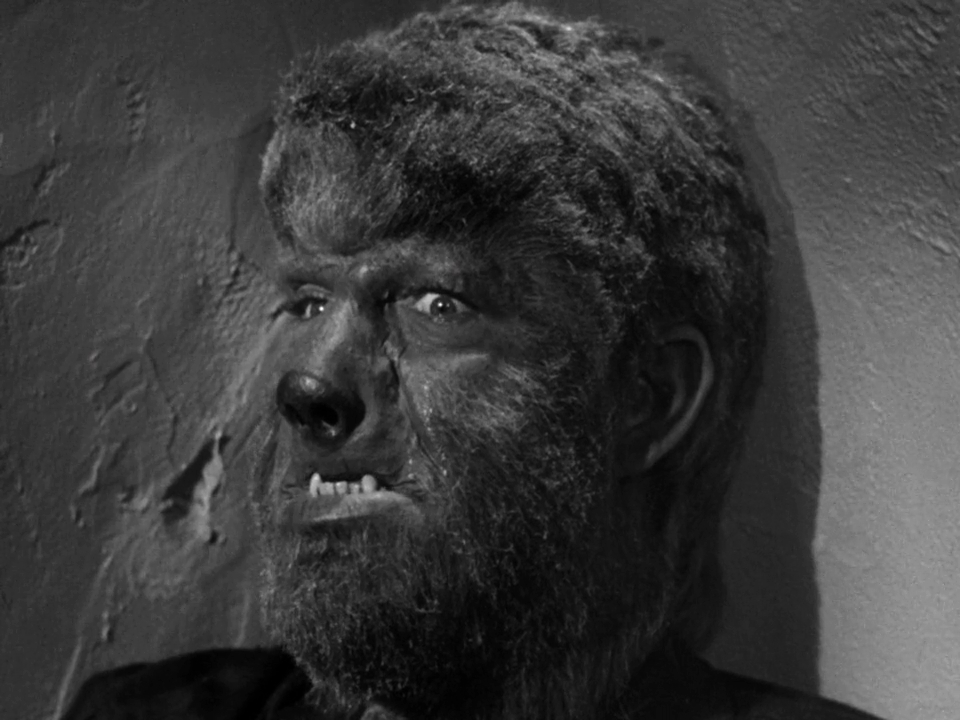
If he looks a little bushier than before, that's because – according to The Titus Andronicus Project – the War had caused a serious shortage of European yak hair, which Jack Pierce previously relied upon for the fur. It's still basically fine. Talbot is then released from his cell and throws himself into the sea. Edelmann follows him on a winch to look for him in the mud, where he finds the reliably unconscious body of Frankenstein's Monster. He brings both back to his not mad hospital/lab/castle, where he then does not revive the Monster because another nurse, trailblazing FEMALE hunchbacked assistant Nina (played by Jane Adams) points out that this would be bad. He does cure Talbot though, which is good, and so ends the Wolf Man's stupid story.
"You have been cured with spores. Now I love you."
We haven't seen a moustache on Talbot before, but obviously he has every right to try one; perhaps he'd just seen "A Matter of Life and Death" and hoped that, in concert with silk pyjamas and head bandage, it would make him look more like David Niven (and not Houdi Elbow). It looks real anyway. Martha O' Driscoll and Jane Adams both look superb, but that doesn't mean they didn't also do their own make-up. Adams really sells the scoliosis too. Her performance as Nina is probably the best thing in the movie, which is not to say that her role isn't exploitative and infantilising. Regardless, she manages to make Nina the protagonist of every scene she's in – heroic, if childishly heroic – until she is horrifically thrown to her death down a trapdoor at the end by Mr. Hyde Edelmann, in long shot, because this film is bad.
Also fine is Glenn Strange's make-up as the Monster, athough, yet again, he has absolutely nothing to do for most of his time onscreen, except lie unconscious on a gurney until called upon to break free from its straps by a mad scientist, so there isn't much that could have gone wrong. If his firey death the next minute, trapped beneath Linda Barker's shelves, reminds you of the end of "Ghost of Frankenstein", that's because it is. The studio literally recycled the footage. And so ends the Monster's non-story. It doesn't look like Strange was given a dresser either:
"Lon Helping Glenn into his Costume" Actual caption.
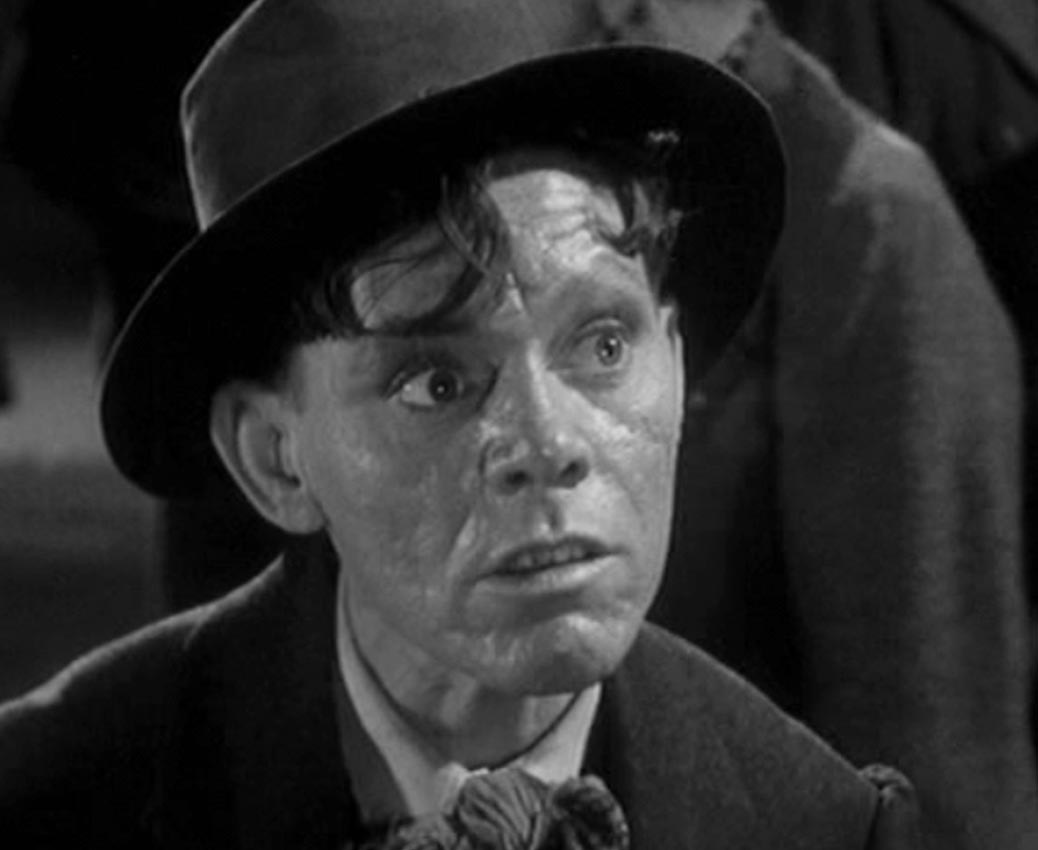
Lionel Atwill's back and probably did some recycling too, wearing the same uniform for Inspector Holtz he wore for Inspector Arnz in "House of Frankenstein" and Inspector Krogh in "Son of Frankenstein", while Skelton Knaggs is a new face, this film's version of the sweaty weirdo who the whole village listens to instead of their Police Inspector, and I'm not sure anyone did his makeup. I'm not sure he's wearing any. I think that face is just Skelton Knagg's deal.
Anything else?
Oh, there's one other death; a scene in which the evil Edelmann toys with, then murders, his gardener. For this one scene we're reminded of the queasily attractive power fantasy that Horror promises, what Steven Moffat called "the game of the monster", While there's so much more to the best of these films than this game, you still have to play it. It's through this game, in fact, we first came as children to Frankenstein, and Dracula, and the Wolf Man, not through "Scooby Doo".
Exactly as we might have dressed up as super heroes, we groaned, and
hissed, and adopted the stiff walk, and suddenly felt power because
people were running from us, because that was the game. And the fangs,
and the claws, and the face paint, and the stick-on bolts, and the scars
were the toys we bought to play that game. We learnt of these monsters
through make-up. House of Dracula forgot the rules of that game however, and there would be no sequel the following year.
In a comment to last week's Drunk Women in Werewolf of London
post, I said I'm "not particularly into being scared. What I like about
'Horror'
is that it's high-stakes magical realism in which a happy ending is not
guaranteed." But thinking about it more, I realise my interest in
the genre, or at least that pantheon of old monsters, runs a lot deeper. This for example is very first drawing I made on page one of my very first school book:
Over the page is the second drawing I ever made at school, which goes some way towards explaining the first:
So I've been looking through old Scooby Doo title sequences to see where this image might come from. "Scrappy Doo"
debuted the year it was drawn, and I remember there being a mummy in
that, because Scrappy unwraps it in a single whisk. Rewatching the titles, it turns out I recalled thempretty much shot for shot,
except for one shot towards the end which surprised the hell out of me. It's of Daphne, Shaggy, Fred and Velma waiting nervously in A&E...
This definitely did not make it into the British broadcasts. I've checked. Instead, we got Scooby and Shaggy running down more corridors. Nor did we get this:
And I'm fine with that; it is an incredibly weird thing to include in the opening titles of a cartoon about monsters, and Scrappy's offputting enough without hauling casualties of his own recklessness out of their hospital beds. Still it's nine minutes into this if you want to see for yourself, and you are, as ever, welcome:
Tomorrow we'll look at "House of Dracula", and maybe talk a little more about white plastic fangs. Oh, and this was on page three:
I'm a dinosaur that's also a jockey? I've no idea.
"Ta-daa! Is this what you like? Is it? We've no idea any more."
There's a reason I spend more time writing about these later film's beginnings than their ends. "House of..." opens superbly. Boris Karloff is back from his theatrical sabbatical. We see only his hand at first, the same way we were introduced to him in "Frankenstein" thirteen years earlier. It shoots out from the hatch of a cell door to throttle a jailor, Karloff's astonishing brow – wreathed with filth and hair – follows, and then the voice – that unaltered South London lisp, sepulchral but local (the ghoul next door), slow yet without vibrato, unwavering as entropy: "Nowwww will you give me my CHALK?" He is given his chalk, and we move into his cell, a beautifully realised, early example of the trope of mad scrawlings on a prison wall. How mad? He's working out how to put a human brain into the skull of a dog.
I just photographed the television.
By 1944 Karloff was as iconic as the Monster he'd created. Onstage he had just finished playing Jonathan Brewster in "Arsenic and Old Lake", the villainous victim of botched plastic surgery that leaves him looking "like Boris Karloff". That's how iconic. (Beautifully, when the play went on tour the role was taken over by Bela Lugosi.) He was the consummate maniac now, top draw, so while his Top Trump Type: "Mad Doctor" is fifth billed on the poster below, Karloff himself got top billing among the cast.
I can't tell who the woman is. Also, this film doesn't really like women.
This would be Karloff's last Horror Film for Universal however, because... huhhh... not just because it was helmed by the uninspiring director of "Ghost of Frankenstein", Erle C. Kenton, but that can't have helped. "Frankenstein Meets the Wolfman"'s director, the far superior Roy William Neil, was busy shooting updated Sherlock Holmes stories with Basil Rathbone, extraordinarily rewatchable adventures, rich in dark character and macarbre detail, which benefit hugely from a solid appreciation of the importance of goodness and evil in a shocker. It's these Holmes pictures, a fan favourite – if not definitive – interpretation of the Great Detective, which stand as Universal's best contribution to the B-movies of this period. "House" meanwhile (the abbreviation, not the TV show), while having some superb stuff in it, doesn't seem to know it. The film lacks care. There's a sense it exists only because audiences still seemed to like this kind of thing. For a few beautiful moments at the beginning though, it looks like this might actually become the theme of the film. So let's return to those moments.
Everything crumbles on the continent. The lightning that gave Karloff life in "Frankenstein" sets him free in "House" by striking his prison. In his escape, he is accompanied by the poster's promised "HUNCHBACK!" hoping for a better body to put his brain in. Daniel, played by J. Carrol Naish, has lovely, big eyes and horrible hair. (Returning to the poster quickly: the promise of a returning character is also the promise of a returning story. "The MAD DOCTOR" will therefore be destroyed by his own hubris, "The WOLF MAN" will look for an escape from his curse, even in death, "FRANKENSTEIN'S MONSTER" will go just sort of go wrong, "DRACULA" will try and steal your wife, and "The HUNCHBACK" will swing from awnings and suffer unrequited love for a Gypsy.) Daniel and Karloff's Professor Niemann, a protegé and fan of the original Dr. Frankenstein, escape into the rain (a welcome attention to detail in a Kenton film) and immediately encounter a travelling Circus of Horrors, run by former Moriarty actor George Zucco in a fez.
This is where things get interesting (and we've aleady had Boris Karloff give a lecture on transplanting a human brain into a dog followed by an exploding prison). The star exhibit of Lampini's two coach carnival is the actual skeleton of Dracula, who, in this film, is an "old legend" rather than a recent casualty, but nobody believes it. "Doubts! Jeers! Cries of Fake! Fake!" Lampini complains of his audience, and who can blame them? And this is what I find interesting, that Horror now finds itself occupying the same simultaneously real and pretend narrative space as Father Christmas...
... If Lampini's cheap sideshow is authentic, maybe all cheap sideshows are. There are two worlds, the world of the story and the world of the audience, and the sideshow is its threshold, perhaps even that same threshold diagnosed as madness in the poster's "MAD DOCTOR", a potent idea in the future of horror writing, which this film inevitably does absolutely nothing with. A familiar refrain now: God, what a film this might have been.
This shot, while included in the film, is arguably better than it.
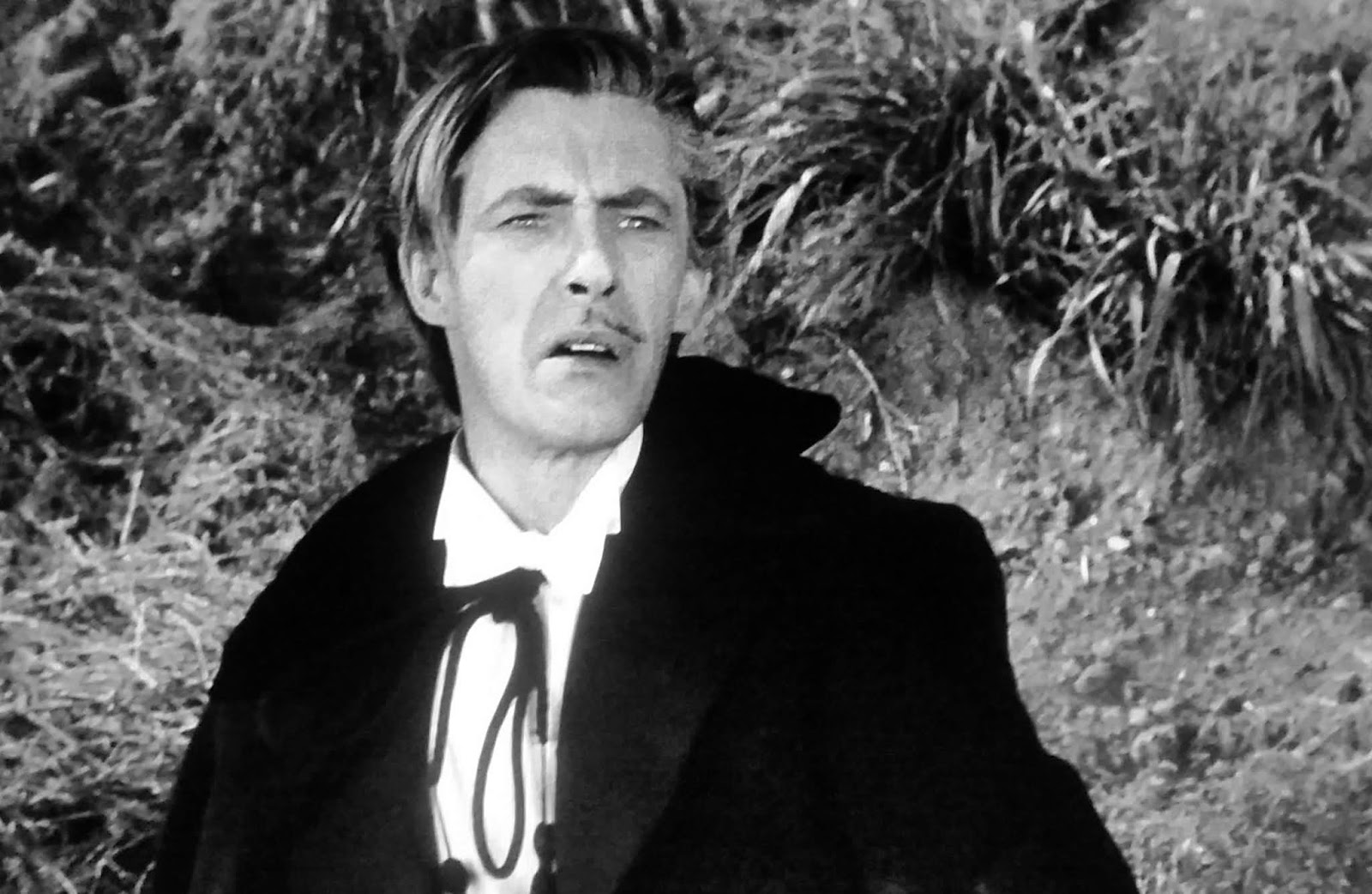
But no, the sideshow is just a plot device. Niemann needs transport, and so has Daniel strangle Lampini and the caravan driver, stealing their identities. A vampire might also come in handy to help him exact revenge on the Burgomaster who imprisoned him, and against his former colleagues who testified for the prosecution, and so – even though Daniel already appears a perfectly adequate multiple murderer – Niemann removes Dracula's stake. Veins appear in the coffin, followed by muscle, followed finally by the suave Pez dispenser John Carradine, licking his lips. He has clearly read Bram Stoker's "Dracula" in preparation for this role, and has the moustache to prove it.
"I don't need to say the line, 'Look into my eyes.'
I can just say it with my eyes. Look. I am such a great Dracula."
Holding the stake over Dracula's heart, Niemann promises to look after his coffin. "In that case," replies the Prince of Darkness, "I will do whatever you wish." Okay, it's rubbish, but here's how I think we're supposed to watch this: Dracula's back, let's not worry how or why, let's just have some Dracula for a bit and treat this as a portmanteau film, a series of stories rather than a single... you know... Let's have some fun with Dracula and see if it's interesting if he's just sort of unremarkable on the surface this time, just thin and randy, and watch him turn into a bat and get invited into a house and talk to a lady about his sexy world of the dead and give her a magic ring and leave holes in Sig Ruman's neck and get chased so hard by the police that his carriage disintegrates, and let's also keep this shot in:
Actually let's return to this shot where his moustache has come off a couple of times, and then the sun rises and he turns into a skeleton and the magic ring falls off so we definitely know the story's over and that it had no consequence on any of its survivors, and then let's get back to Professor Niemann who didn't even look after his coffin.
Which we do. Niemann and Daniel have arrived in the village of Vasaria, so that Niemann can pick up Frankenstein's old notebooks. Actually, in this film the village is called Frankenstein, but there's the burst dam and castle from "Frankenstein Meets the Wolfman" so it's definitely the film that's wrong, and I'm right, and this is Vasaria. In the ruins of the castle Niemann also finds Frankenstein's Monster and the Wolfman frozen in the ice, presumably because people really liked the ice in the last film. No wait, this is the same ice cave as before, isn't it? Is it? It's hard to keep track.
Niemann and Daniel's descent into the glacier is a beatifully orchestrated set piece, with the land giving way beneath Daniel entirely convincingly. Again, a crumbling world, and Karloff in particular is dressed for it superbly. But again, the image deserves a better film:
The ice melts, Lon Chaney's Larry Talbot the Wolf Man resumes consciousness, and is natually depressed to find himself still alive a third time. He explains to Niemann what happened in the previous film – refers to Dr. Mannering, the whole kaboodle – and Niemann promises.... Do you know what? I can't remember... to look after his shoes or something, if Talbot helps to cart Frankenstein's handily unconscious Monster to the Professor's own lab in the village of Visaria. With an "i". That's the name of Niemann's village. Some villages just have very similar names. It's a hundred kilometers away, and joining them will be the Gypsy Ilonka, played by Elena Verdugo, for there are Gypsies in Vasaria, not the Gypsies of 'The Wolfman", but one-dimensional, heavily sexualised stereotypes, one of whom Daniel saves from a whipping. So now Ilonka's with them, and very grateful, and very playful. She tickles the driver's ankle, that kind of thing. When Larry Talbot takes the reins from Daniel, romantic complications ensue. The War is definitely not a thing.
Braining Bad. "Frankenstien Meets the Wolfman"'s cinematographer George Robinson shot all this, which might be why it looks so great.
We arrive in Visaria with an "i", where Daniel kidnaps Niemann's two former colleagues, Ullman and Strauss (MICHAEL MARK!) and Frankenstein's Monster is "preserved" with steam in Niemann's pub-tat-strewn lab, a gig that even first-time Monster actor Glenn Strange couldn't be arsed to lie down for, and so an old Lon Chaney mask glued to a dummy takes his place until the story can work out what to do with him. Daniel meanwhile loves Ilonka, but Ilonka loves Larry Talbot, so Daniel wants Niemann to put his brain put into Talbot's body. But Niemann wants to put the Monster's brain into Talbot's body, and Ullman's brain into the Monster's body, and Larry Talbot's brain into Strauss' body. It's like The
Seagull. Talbot then transforms into the Wolf Man in front of a mirror and kills a Visarian, and the mob get their torches. He has a nice scene explaining to Ilonka that he absolutely remembers what it's like to be the Wolf Man, and what it's like to want to kill. He also – having accompanied Niemann all this distance in the hope of finding a science that can put him out of his misery – explains that the only way he can be killed is by a silver bullet shot by someone who loves him WHICH IS NEWS TO ME.
Anyway, that then happens:
The Wolf Man attacks Ilonka, she shoots him, and they both die. So ends Larry Talbot's least creepy relationship with a woman by far, while Daniel is left heart-broken. The End. Surely. Oh wait, no! Frankenstein's Monster! He's still strapped to the gurney!
Speaking of gurny:
Daniel takes his grief out on Niemann, who has yet to do a damn thing for him in return for all those helpful murders. Professor Niemann lied to Daniel and he lied to Dracula – in fact I'd love to believe he was secretly a quack all along, which is why he kept everyone waiting for their new brains in Visaria. After all he never performs a transplant in the end, and while the Monster was revived, Talbot was also revived without any boffinry. Clearly, however, the Monster upon regaining consciousness considers Niemann his saviour, so I suppose this film did as well. Strange wakes with a face like a landed fish, mouth wide and soundless, interestingly
incapacitated. Is he smiling, or did Karloff teach him that silent scream? Or wait, is he going for palsy? Anyway, he bursts from his restraints and throws Daniel out of the window. Like Dracula, the Monster is reduced to just another of Niemann's goons. The mob then arrive and set fire to the bog and, dragging the unconscious Niemann out of his lab, the Monster escapes into some quicksand. Everyone loves this mess, so Universal have to make yet another one. Karloff, intensely aware that Horror is allowed to be anything but mediocre, goes off instead to work on some extraordinary collaborations with Val Lewton at RKO: "Isle of the Dead", "Bedlam" and "The Bodysnatcher". Bobby Pickett records "The Monster Mash". The BBC ban it. The End.
Your homework for next week is 1945's "The House of Dracula". There will be blood. I'm not actually suggesting you watch it, I'd never want to be responsible for that, but now I've said that, aren't you curious? I mean, everyone died in this one, how will they come back? And will John Carradine be Dracula again? Will his top hat turn into a bit of a bat? Will I ever get round to writing about the Wolf Man make up? Is Frankenstein even in this bloody one? Will it be a really short blog? Find out!