As America marks Bonfire Night just as we marked Independence Day, let's let it happen and just crawl down a hole, because it's all okay, look into the screen, closer, I found the hole. Come on. Let's go. Just for now. Into the screen...
Once you're out, don't look up how old Kane Pixels is (no relation) or how he shot this. But do look up parts three and one, especially if you're into horror and into general and zillenial definitions of the liminal (thresholds and corridors) because both The Oldest View and its creator are doing something quite firsty. In fact, look up how it was shot as well, and maybe also look at this video about Utopian Botanist Julien Bercheron and the Vally View Mall, Texas, which mysteriously appeared once in my recommendations, and led me to this hole.
On Tuesday I held a place for the Webcamming Chronicles (a very different show from Spike) which Maud Madlyn and Andrès Montes Zuluaga will be performing again tonight at the Cockpit Theatre as part of Trojana – either the name of their company, or of the very specific sex-work-based project this show is a part of, I'm not quite sure which – and as this is a recommendation I'm going to try to get it written and posted while there's still time to get a ticket. There's a Q and A after tonight's show as well. I guarantee you will have questions, but I can't guarantee you'll necessarily want the answers.
"For
this particular piece, performer Maud Madlyn took on her most demanding
personal and professional challenge to date: work as an adult webcam
model and trainer. She infiltrated the industry from a
clandestine studio in Cali, Colombia, second world-leading power in this
business. Why? To see what sexual desire looked and sounded like when
decency and political correctness were stripped away."
Along with many mutual friends from the London Dungeon I'd known Maude from when she ran the Etcetera Theatre above the Oxford Arms in Camden, and after she left the country – (side note: I love that she describes herself as "French-born" rather than French; I might start describing myself as British-born, it immediately seems a little freeing) – I knew from her instagram posts she was doing something involving not wearing clothes, but it wasn't until I saw this show on Tuesday that I realised her specific level of commitment, and that Trojana may have taken its name from the horse.
Image taken from this review of Webcamming Chronicles' Covid times, online premiere
Not knowing much about the show beforehand however probably made it more unforgettable, and so I don't want to say too much more about Andrès' and Maude's investigations (I also want to get this posted pretty quickly, as I said) but – with the proviso that every audience will make every show different, and so what it felt like when I saw it might not be what it feels like any other night – I will say that the two things I probably loved most about the show were: 1) That I really wasn't prepared for it, and that it didn't seem to care – content warnings are incredilbly important but I hadn't realised until I watched this how much they also really make me feel like a consumer, like I'm in the shops – but I only loved this because 2) While a piece of staged journalism, it never stopped being art, by which I mean liminal, by which I'm trying to find a word that sounds less pretentious but still describes the necessary protective shared understanding that you don't have to immediately engage with the work as fact, that you can interrogate it without feeling you're interrogating the artist. That's what I mean. That thing that Nanette didn't have. Interrogating a work means you can create a conversation within yourself. And I don't know if I ever heard these specific words said, but the phrase "unsafely human" was something powerful I was left with,
Today was spent finally catching up with Sarah Airress' engrossing account, over more than a year's worth of blogging, of her trip to Antarctica, to research a graphic adaptation of Apsley Cherry-Garrard's memoir of Scott's 1911 Terra Nova expedition, The Worst Journey In The World. I hope Sarah doesn't mind if I share some of it here.
From The One Show, April, 2020
Emotional, educational, and beautifully documented with her own
photographs, the trip to McMurdo took place two Novembers ago,
months before Covid saw the rest of us having to rethink our living
arrangements, and Airress was there for a month. But her account, begun in September of 2019, has continued to run on until at least last Saturday, which is what I powered through today, transported by every paragraph.
One of the interesting things I learnt: In dry air, minus 10ºC can still feel "very mild".
Most recently, she wrote about her visit to the remains of an already misshapen stone igloo that "Cherry" built in 1911, during the disastrous journey to find Emperor Penguin eggs that gave his memoir its title, and she quoted his return to the base hut:
Bread and jam, and cocoa; showers of questions; "You know this is the
hardest journey ever made," from Scott; a broken record of George Robey
on the gramophone which started us laughing until in our weak state we
found it difficult to stop. ... Then into my warm blanket bag, and I
managed to keep awake just long enough to think that Paradise must be
something like this.
We slept ten thousand years ... [301]
I looked out the George Robey, and could only find something from 1913. Still, I thought it might give me a taste, and tried to imagine men who only twenty-four hour hours earlier had been so uncomfortable that they willingly risked death, laughing themselves silly to this:
It was alright, I suppose. Not as ticklish as I'd hoped, I thought, but tastes had clearly changed. Then I re-read what Cherry wrote: "a broken record of George Robey on the gramophone"... A broken record! And immediately I could hear them, high as kites, their past no more distant than my own.
From Sarah's record of the 28-sleeping Cape Evans hut (source).
About her return towards the end of 2019, Airress writes of the "thin places" – an apparently Celtic term, and possible improvement upon the word "liminality" which I've been trying to find a replacement for for years now. You can see, and indeed buy, more of Sarah's work here. And her brilliant visualisations of John Finnemore's Cabin Pressure, which is how I first knew about her, are viewable here.
An insufficient tribute to these highly-tasked human interfaces, I know, but I ended up making two rounds for last night's quiz so here is our gentle opener: No multiple choice this time, no titles to match, and some usual suspects. All you have to do is name the film from the receptionist. Answers as ever will be posted in the comments...
A nice plug in the Guardian yesterday for Gemma Brockis' Oddvent calendar, and thanks to Gemma for allowing me to grant all of you ole unattendees Very Important Person access, as we say in the threshold business, through today's door. Click here to open it and witness my contribution – possibly inspired by the Cosmic Shambles' many show-and-tells – there's more information about the calendar here, and if you need one the password for today is "help". (My first idea was to giftwrap an egg, but I'm not doing that now, so giftwrapping an egg is still going.) Enjoy!
UPDATE: Now the Calendar has vanished, my contribution's up on youtube.
One of the more interesting discoveries I made studying "English" was how self-aware the first English fiction was: Medieval writers couldn't just launch into a story they knew to be untrue, they had to first tell you about the person they met who'd told it to them, or about how they'd fallen asleep and dreamt it. I loved being carried over the threshold like this. It probably inspired the creation of Laika as a narrator for Time Spanner, and it definitely endeared me to the shunt ethos that a show begins as soon as a venue is entered. However, subsequent traditions decided this quarantine between the real world and the world of the work was a waste of time, and self-awareness became considered self-indulgent and "meta-textual". But it absolutely used to be the norm.
The post-medieval, sixteenth-century-penned Don Quixote – one of the first novels – purports to be the story of a real man, which means a lot of its second half is spent with Quixote dealing with the fallout from the publication of its first half (UPDATE: like Borat) and I'm sure this wouldn't have seemed self-indulgent in 1605. The point of the book is that Don Quixote exists, against his will, in the real world, a world which also, therefore, contains this book.
I probably wasn't the only child who wondered as what characters in Eastenders watched on BBC1 at 7:30pm.
It is only sitting down to post about how disappointingly intimidated I feel not just by the tone but by the content of J. Theophrastus Bartholomew's introduction to his Games You Can Play In Your Head - a book promoted by my new youtube heroes the Corridor Crew, and edited down by two of their number from an initial, sixteen-volume set found in a yard sale in Bayport, Minnesota - a book I was incredibly excited to receive, but whose opening pages contained such red flags as "You might think to yourself: but what about all my friends? To which I retort, of course, and without hesitation: who needs them?" or "if you are an adult who attempts to function as a cog in the blood-soaked machine we call the American Dream..." or "Say it aloud: I am playing a game, Father. A game that requires you to leave me in peace and allow me to be a more fully formed human" - it is literally only now, sitting down to write about how worried I am to continue reading this book, that it occurs to me what may already have been blindingly obvious to you: that there is of course no J. Theophrastus Bartholomew. That there never was an original sixteen-volume set, that this is an original work which would explain why J. Bartholomew's name is not on the cover, and that Sam Gorski and D. F. Lovett are entirely aware of how intimidating he sounds because they made him up to sound like an embittered, nihilistic kook because that's the joke. So all I want to share with you now, having sat down, is my absolutely genuine relief at that realisation. He never existed. Oh my god. It's okay. It was a joke. Oh. That feels so good.
Colours aren't reflected light in the concept art of Mary Blair, they're light sources. The Disney films she worked on were nocturnal fairy tales, intimately sunless and perfect for dark rides. There were concepts in her concept art too, like filling Wonderland with signage for example.
That seems apt. If Carroll's stories had a villain it was probably words. Tangentially, it's possible that I've been misusing the word "liminal". I've used it describe the location of an act of the imagination, but strictly speaking it doesn't mean pretend-y so much as between-y, coming from the
Latin word for threshold.
It was the video below that brought this to my attention. I know nothing about the contributor but my algorithms made a hell of a recommendation because Solar Sand's search for the fabled "backrooms" is absolutely packed with potential rabbit holes: "noclipping", kenopsia, the actual length of a fire hydrant, what kind of rooms inspire nostalgia in Russian millenials... Wait. What does the word "threshold" come from?
I'd never picked up a book by Schuiten or Peeters until today, but my excellent sister gave me Samaris for my birthday back in November, and finally reading it has felt a lot like nostalgia. These are the dreams I'd had as a nineteen-year-old, of being assigned to investigate a city and finding only scenery, something to climb or climb into, whose passages and ledges might take you to a roof from where you could finally see it all. Kafkaish adventures where the twist was that nothing will happen, that the city is ultimately unvisitable, these were fairy tales of tourism, and although I may have forgetten how big a part they played in my adolescence, I still find it hard to know how to engage with a place beyond just heading to its highest point.
How often is the last film in a series the one you'll have almost definitely seen first?
I saw "Abbott and Costello Meet Frankenstein" long before I ever sought out "Frankenstein" or "Dracula", and it's worth noting how smoothly the film went down with the rest of my childhood diet: "The Goonies", "Young Sherlock Holmes", Bugs Bunny's toying with Elmer Fudd, Han Solo's screaming flight from Stormtroopers, nearly all of Spielberg's output, even "Dangermouse" and "The Hitchhikers Guide to the Galaxy" all shared this tone of Horror Comedy, so much so that it seemed the only tone going, and all of the above may have learnt a thing or two from "A and C Meet F". Ignoring the duff bit with the chair, consider the clip below (which comes towards the end of the picture, so might be a little SPOILER-y): sitcom director Charles T. Barton doesn't just juggle the comedy and threat, he protracts the threat long enough for it to become comic – a relentless piling on of threats that seems at least as big an influence on "Indiana Jones" as the joke-free adventure serials normally credited.
It's worth noting too how different this films's strengths are from the kind of routine which had made Bud and Lou famous stars of burlesque. The pair are best known nowadays for two entirely separate contributions to Culture: this film, and the sustained miscommunication of "Who's On First?" – still one of the most famous sketches ever written, over eighty years later. Their timing was atomic, but "AaCMF" has no classic spoken routines. Its laughs come almost exclusively from Lou Costello's obliviousness to, or acknowledgement of, danger. Few would put Abbott and Costello in the same comedy pantheon as Laurel and Hardy, but you always knew how the latter pair would react to a threat – they'd gulp, and go "Mimimi!" or "Whoahhh!" – whereas Costello innovated an entire language's worth of scare takes. With no spoken material he trusted enough to fall back upon, he was given little choice. Fortunately, his writers (credited here) had a far clearer idea of how funny this was going to be than Lou did, but still, with no live audience on set to gauge the laughs, this absence of patter clearly terrified him.
The Casino Theatre, Broadway. Bud and Lou played here
but really I just ike the picture.
"No way I'm doing this crap!" he apparently complained of the script, "My five-year-old daughter could write something better!" It should be noted then what an improvement this film's plot is over previous Frankenstein Wednesdays. Five-year-old Paddy Costello may have been able to write better, but Curt Siodmak couldn't.
Consider, if you can bare to, we who know, the screenwriter's three previous attempts to bring
the monsters together:
In "Frankenstein Meets the Wolf Man"
Larry Talbot seeks out
the Scientist, hoping to be rid of his werewolf curse by learning the
secret of
eternal death. Finding Frankenstein's Monster frozen in ice, he frees it, then transforms into a werewolf in the midst of transferring
his own
"life force" into its body. They then fight.
In "House of Frankenstein" a deranged
former associate of Frankenstein escapes from a dungeon, finds
Dracula's skeleton in a travelling circus and briefly brings it back to life to
wreak revenge. He then unrelatedly finds the bodies of Larry Talbot and Frankenstein’s
Monster frozen in ice and thaws them out, hoping to put the Monster's brain
into Talbot's body, but everyone dies before any of this is
achieved.
In "House of Dracula" Larry Talbot and Dracula independently
approach a doctor completely unconnected with Frankenstein,
hoping to be cured of their respective spookinesses. The doctor agrees to treat
Dracula, Talbot impatiently throws himself into the sea, and looking to retrieve
his body the doctor finds Frankenstein's Monster buried in some mud. Talbot is
then cured, Dracula turned into a skeleton, and the doctor goes mad and brings
the Monster back to life for just over a minute before everything explodes.
By contrast, in "Abbott and Costello Meet Frankenstein" Dracula wants to revive Frankenstein's Monster, and Larry
Talbot the Wolf Man is trying to stop them. That's it.
It’s not just the simplicity of this story that comes as such a relief, it’s
the dramatic improvements made upon delineating its main characters' whole deal: Dracula
wants mastery, the Monster wants a master, and Talbot wants to do good rather
than just kill himself – a mission tragically hampered by his own curse. As a result of this clarity, Lon Chaney Junior, Glenn Strange, and even Bela Lugosi all give arguably their greatest performances in the roles for which they are best known, and it's now three o'clock in the morning so this will have to be continued...
"Ta-daa! Is this what you like? Is it? We've no idea any more."
There's a reason I spend more time writing about these later film's beginnings than their ends. "House of..." opens superbly. Boris Karloff is back from his theatrical sabbatical. We see only his hand at first, the same way we were introduced to him in "Frankenstein" thirteen years earlier. It shoots out from the hatch of a cell door to throttle a jailor, Karloff's astonishing brow – wreathed with filth and hair – follows, and then the voice – that unaltered South London lisp, sepulchral but local (the ghoul next door), slow yet without vibrato, unwavering as entropy: "Nowwww will you give me my CHALK?" He is given his chalk, and we move into his cell, a beautifully realised, early example of the trope of mad scrawlings on a prison wall. How mad? He's working out how to put a human brain into the skull of a dog.
I just photographed the television.
By 1944 Karloff was as iconic as the Monster he'd created. Onstage he had just finished playing Jonathan Brewster in "Arsenic and Old Lake", the villainous victim of botched plastic surgery that leaves him looking "like Boris Karloff". That's how iconic. (Beautifully, when the play went on tour the role was taken over by Bela Lugosi.) He was the consummate maniac now, top draw, so while his Top Trump Type: "Mad Doctor" is fifth billed on the poster below, Karloff himself got top billing among the cast.
I can't tell who the woman is. Also, this film doesn't really like women.
This would be Karloff's last Horror Film for Universal however, because... huhhh... not just because it was helmed by the uninspiring director of "Ghost of Frankenstein", Erle C. Kenton, but that can't have helped. "Frankenstein Meets the Wolfman"'s director, the far superior Roy William Neil, was busy shooting updated Sherlock Holmes stories with Basil Rathbone, extraordinarily rewatchable adventures, rich in dark character and macarbre detail, which benefit hugely from a solid appreciation of the importance of goodness and evil in a shocker. It's these Holmes pictures, a fan favourite – if not definitive – interpretation of the Great Detective, which stand as Universal's best contribution to the B-movies of this period. "House" meanwhile (the abbreviation, not the TV show), while having some superb stuff in it, doesn't seem to know it. The film lacks care. There's a sense it exists only because audiences still seemed to like this kind of thing. For a few beautiful moments at the beginning though, it looks like this might actually become the theme of the film. So let's return to those moments.
Everything crumbles on the continent. The lightning that gave Karloff life in "Frankenstein" sets him free in "House" by striking his prison. In his escape, he is accompanied by the poster's promised "HUNCHBACK!" hoping for a better body to put his brain in. Daniel, played by J. Carrol Naish, has lovely, big eyes and horrible hair. (Returning to the poster quickly: the promise of a returning character is also the promise of a returning story. "The MAD DOCTOR" will therefore be destroyed by his own hubris, "The WOLF MAN" will look for an escape from his curse, even in death, "FRANKENSTEIN'S MONSTER" will go just sort of go wrong, "DRACULA" will try and steal your wife, and "The HUNCHBACK" will swing from awnings and suffer unrequited love for a Gypsy.) Daniel and Karloff's Professor Niemann, a protegé and fan of the original Dr. Frankenstein, escape into the rain (a welcome attention to detail in a Kenton film) and immediately encounter a travelling Circus of Horrors, run by former Moriarty actor George Zucco in a fez.
This is where things get interesting (and we've aleady had Boris Karloff give a lecture on transplanting a human brain into a dog followed by an exploding prison). The star exhibit of Lampini's two coach carnival is the actual skeleton of Dracula, who, in this film, is an "old legend" rather than a recent casualty, but nobody believes it. "Doubts! Jeers! Cries of Fake! Fake!" Lampini complains of his audience, and who can blame them? And this is what I find interesting, that Horror now finds itself occupying the same simultaneously real and pretend narrative space as Father Christmas...
... If Lampini's cheap sideshow is authentic, maybe all cheap sideshows are. There are two worlds, the world of the story and the world of the audience, and the sideshow is its threshold, perhaps even that same threshold diagnosed as madness in the poster's "MAD DOCTOR", a potent idea in the future of horror writing, which this film inevitably does absolutely nothing with. A familiar refrain now: God, what a film this might have been.
This shot, while included in the film, is arguably better than it.
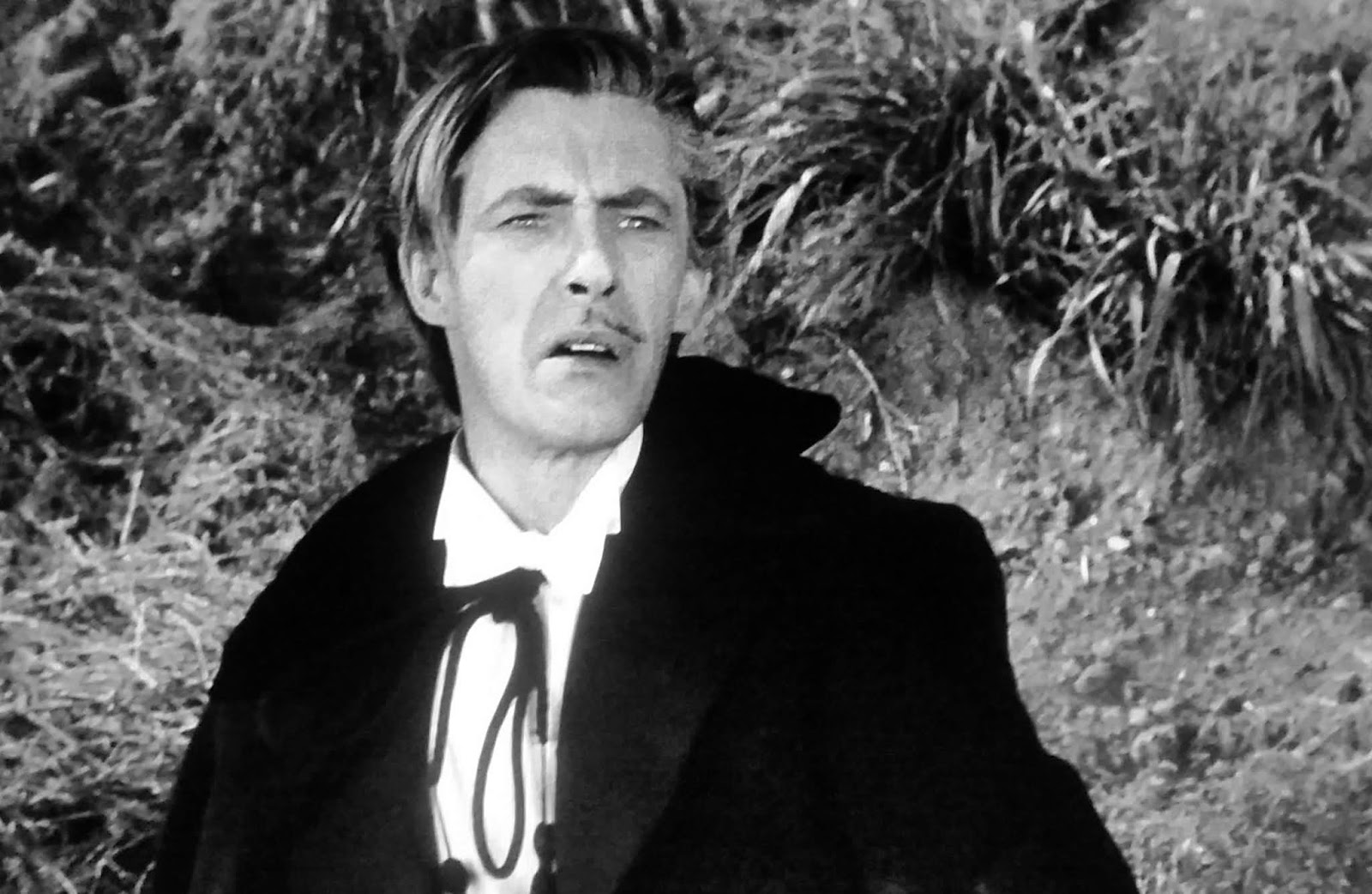
But no, the sideshow is just a plot device. Niemann needs transport, and so has Daniel strangle Lampini and the caravan driver, stealing their identities. A vampire might also come in handy to help him exact revenge on the Burgomaster who imprisoned him, and against his former colleagues who testified for the prosecution, and so – even though Daniel already appears a perfectly adequate multiple murderer – Niemann removes Dracula's stake. Veins appear in the coffin, followed by muscle, followed finally by the suave Pez dispenser John Carradine, licking his lips. He has clearly read Bram Stoker's "Dracula" in preparation for this role, and has the moustache to prove it.
"I don't need to say the line, 'Look into my eyes.'
I can just say it with my eyes. Look. I am such a great Dracula."
Holding the stake over Dracula's heart, Niemann promises to look after his coffin. "In that case," replies the Prince of Darkness, "I will do whatever you wish." Okay, it's rubbish, but here's how I think we're supposed to watch this: Dracula's back, let's not worry how or why, let's just have some Dracula for a bit and treat this as a portmanteau film, a series of stories rather than a single... you know... Let's have some fun with Dracula and see if it's interesting if he's just sort of unremarkable on the surface this time, just thin and randy, and watch him turn into a bat and get invited into a house and talk to a lady about his sexy world of the dead and give her a magic ring and leave holes in Sig Ruman's neck and get chased so hard by the police that his carriage disintegrates, and let's also keep this shot in:
Actually let's return to this shot where his moustache has come off a couple of times, and then the sun rises and he turns into a skeleton and the magic ring falls off so we definitely know the story's over and that it had no consequence on any of its survivors, and then let's get back to Professor Niemann who didn't even look after his coffin.
Which we do. Niemann and Daniel have arrived in the village of Vasaria, so that Niemann can pick up Frankenstein's old notebooks. Actually, in this film the village is called Frankenstein, but there's the burst dam and castle from "Frankenstein Meets the Wolfman" so it's definitely the film that's wrong, and I'm right, and this is Vasaria. In the ruins of the castle Niemann also finds Frankenstein's Monster and the Wolfman frozen in the ice, presumably because people really liked the ice in the last film. No wait, this is the same ice cave as before, isn't it? Is it? It's hard to keep track.
Niemann and Daniel's descent into the glacier is a beatifully orchestrated set piece, with the land giving way beneath Daniel entirely convincingly. Again, a crumbling world, and Karloff in particular is dressed for it superbly. But again, the image deserves a better film:
The ice melts, Lon Chaney's Larry Talbot the Wolf Man resumes consciousness, and is natually depressed to find himself still alive a third time. He explains to Niemann what happened in the previous film – refers to Dr. Mannering, the whole kaboodle – and Niemann promises.... Do you know what? I can't remember... to look after his shoes or something, if Talbot helps to cart Frankenstein's handily unconscious Monster to the Professor's own lab in the village of Visaria. With an "i". That's the name of Niemann's village. Some villages just have very similar names. It's a hundred kilometers away, and joining them will be the Gypsy Ilonka, played by Elena Verdugo, for there are Gypsies in Vasaria, not the Gypsies of 'The Wolfman", but one-dimensional, heavily sexualised stereotypes, one of whom Daniel saves from a whipping. So now Ilonka's with them, and very grateful, and very playful. She tickles the driver's ankle, that kind of thing. When Larry Talbot takes the reins from Daniel, romantic complications ensue. The War is definitely not a thing.
Braining Bad. "Frankenstien Meets the Wolfman"'s cinematographer George Robinson shot all this, which might be why it looks so great.
We arrive in Visaria with an "i", where Daniel kidnaps Niemann's two former colleagues, Ullman and Strauss (MICHAEL MARK!) and Frankenstein's Monster is "preserved" with steam in Niemann's pub-tat-strewn lab, a gig that even first-time Monster actor Glenn Strange couldn't be arsed to lie down for, and so an old Lon Chaney mask glued to a dummy takes his place until the story can work out what to do with him. Daniel meanwhile loves Ilonka, but Ilonka loves Larry Talbot, so Daniel wants Niemann to put his brain put into Talbot's body. But Niemann wants to put the Monster's brain into Talbot's body, and Ullman's brain into the Monster's body, and Larry Talbot's brain into Strauss' body. It's like The
Seagull. Talbot then transforms into the Wolf Man in front of a mirror and kills a Visarian, and the mob get their torches. He has a nice scene explaining to Ilonka that he absolutely remembers what it's like to be the Wolf Man, and what it's like to want to kill. He also – having accompanied Niemann all this distance in the hope of finding a science that can put him out of his misery – explains that the only way he can be killed is by a silver bullet shot by someone who loves him WHICH IS NEWS TO ME.
Anyway, that then happens:
The Wolf Man attacks Ilonka, she shoots him, and they both die. So ends Larry Talbot's least creepy relationship with a woman by far, while Daniel is left heart-broken. The End. Surely. Oh wait, no! Frankenstein's Monster! He's still strapped to the gurney!
Speaking of gurny:
Daniel takes his grief out on Niemann, who has yet to do a damn thing for him in return for all those helpful murders. Professor Niemann lied to Daniel and he lied to Dracula – in fact I'd love to believe he was secretly a quack all along, which is why he kept everyone waiting for their new brains in Visaria. After all he never performs a transplant in the end, and while the Monster was revived, Talbot was also revived without any boffinry. Clearly, however, the Monster upon regaining consciousness considers Niemann his saviour, so I suppose this film did as well. Strange wakes with a face like a landed fish, mouth wide and soundless, interestingly
incapacitated. Is he smiling, or did Karloff teach him that silent scream? Or wait, is he going for palsy? Anyway, he bursts from his restraints and throws Daniel out of the window. Like Dracula, the Monster is reduced to just another of Niemann's goons. The mob then arrive and set fire to the bog and, dragging the unconscious Niemann out of his lab, the Monster escapes into some quicksand. Everyone loves this mess, so Universal have to make yet another one. Karloff, intensely aware that Horror is allowed to be anything but mediocre, goes off instead to work on some extraordinary collaborations with Val Lewton at RKO: "Isle of the Dead", "Bedlam" and "The Bodysnatcher". Bobby Pickett records "The Monster Mash". The BBC ban it. The End.
Your homework for next week is 1945's "The House of Dracula". There will be blood. I'm not actually suggesting you watch it, I'd never want to be responsible for that, but now I've said that, aren't you curious? I mean, everyone died in this one, how will they come back? And will John Carradine be Dracula again? Will his top hat turn into a bit of a bat? Will I ever get round to writing about the Wolf Man make up? Is Frankenstein even in this bloody one? Will it be a really short blog? Find out!
"To let understanding stop at what cannot be understood is a high
attainment.
Those who cannot do it will be destroyed on the lathe of heaven."
Chang Tzu
Try telling that to Dangermouse.
And still on the subject of maps...
This is the ball-ache that greets any reader opening Ursula K. Le Guin's "A Wizard of Earthsea". For much of the book, it appears to be an example of exactly the kind of map-at-the-beginning-of-a-book I talked about dreading in yesterday's post – the kind you're meant to constantly refer back to while following the hero's journey, an impediment to reading, crammed with unnecessary detail, imprisoning upon the page a world which the act of reading is supposed to liberate. But Le Guin's brilliant, and clearly knew what she was doing, because SPOILERS! the book's climax takes place off the map. It's only beyond the edge of the world that Ged can name his shadow, and – like Dangermouse in "Custard" – let reality catch up with him. The map isn't here to show us where the hero went, but to show us, physically in fact, what he had to escape. It's an excellent way of depicting magic. I'm guessing. I'm very glad I re-read it.
When does this happen in the book though?
I still do not remember this happening in the book.
"Every story must make its own rules. And obey them." I was inspired to
read more Le Guin because of an excellent documentary no longer
available on iplayer but still viewable here. And I haven't read any of the other Earthsea books yet. Nor worked out what the point of the map at the beginning of "The Dispossessed" was either so, you know, maybe I'm wrong and she just liked maps.
One other takeaway – Character after character offers to tell Ged the name
of his shadow and save him his journey, but it's clear he's meant to turn them down, get lost, and work it out for himself, which – taken with what I
remember of "The Lathe of Heaven" – leads me to ask: Does anyone know if Ursula K. Le Guin had a beef with therapy?
I'm very sympathetic to the idea that all the best fiction has a map at
the front, but I'm not a complete convert. Different maps serve
different puposes: the map in The Hobbit is a call to adventure, while the maps of the Hundred Acre Wood or Moominvalley
are more like welcoming gifts. Both types are pretty scant on detail, and
both are types I like: maps you don't have to constantly refer to. It's
not just laziness that makes me favour these maps, it's that they
make no serious attempt to pretend – as some fantasies do – that
imagined lands can be depicted objectively.
It was Nerdwriter's video below that got me thinking about this (that, and the
fact I just finished "A Wizard of Earthsea" but I'll write about that
map tomorrow).
According to Nerdwriter the "bill of goods" of a fantasy is not
World-Building, but "the ideas and insights that spring forth from the
explosive act of reading":
"Like
all books, Viriconuim is just some words. There is no place, no
society, no dependable furniture to 'make real'. You can't read it for
that stuff, so you have to read it for everything else."
I was delighted to see Harrison's name pop up. I've always loved "In Viriconium" – there's a detectable Viriconian influence here
for example. Like Bastian's Fantasia in "The Neverending Story" the
city is unmappable. In my spare periods at school, I used to walk along
the then undeveloped South Bank in the shadow of Bankside Power Station
(now Tate Britain) looking for places Viriconium might be, scouting liminal
locations. And any reader in any other city could do the same.
That's one of the reasons I love Orson Welles' film of "The Trial", whence all these images (more here).
Unable to shoot in Prague, he had to invent his own dream city from
bits of Paris, Milan, Rome, Dubrovnik and Zagreb – effectively shooting
the film in Viriconium. Terry Gilliam's own stab at Kafka a couple of decades
later, "Brazil",
would conjure a similar city out of real locations; its setting, according to the opening title – "somewhere in the twentieth century" – similarly
vague.
So that's why I'm not a-hundred-per-cent a fan of maps at the beginning
of books. Fantasy locations are unvisitable. Definitive visualisations are
impossible. That said...
I can't have been the only child to think Tolkein was taking
the piss with his illustations to "The Hobbit". Show us the bloody
monsters.