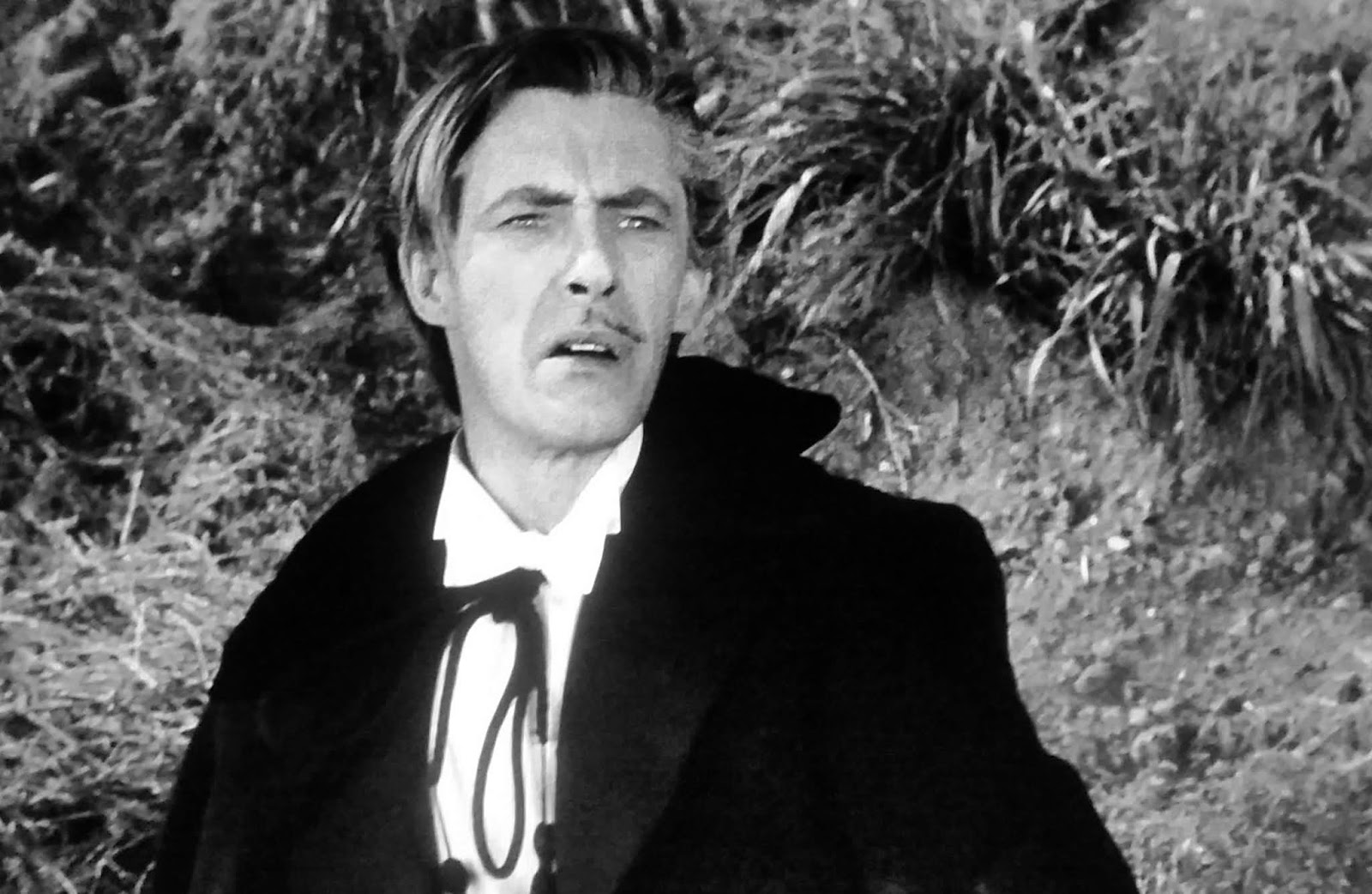
Morning! I hadn't heard of him until last week, but, continuing with the unintentional theme of German enertainers, posted below is a wordless sketch from the late Vicco von Bulow – or Loriot – a writer, comedian,
and animator for whom I can't think of any English-speaking
equivalent. (This is why I always sit in the seat I have been allocated. Also, interruptions are funny.)
Carl Herman Unthan completed "Notes From the Life of an Armless Man" when he was seventy-seven. He called it a "pediscript" because he'd typed it with his feet. During the First World War, according to this article, he served with the German Army "in a morale role" visiting new amputess, but he was chiefly a Vaudevillian, and in 1913 his typing skills, and more besides, were recorded for posterity when he was cast as Arthur Stoss in the Danish silent film "Atlantis", at the age of sixty-five. I'm not too sure about my choice of music to accompany this footage, but I do think Carl is
cool.
"Although his abilities were impressive, critics of Atlantis felt his appearance in the film was simply extraneous and non-integral to the story."Wikipedia
"Ta-daa! Is this what you like? Is it? We've no idea any more."
There's a reason I spend more time writing about these later film's beginnings than their ends. "House of..." opens superbly. Boris Karloff is back from his theatrical sabbatical. We see only his hand at first, the same way we were introduced to him in "Frankenstein" thirteen years earlier. It shoots out from the hatch of a cell door to throttle a jailor, Karloff's astonishing brow – wreathed with filth and hair – follows, and then the voice – that unaltered South London lisp, sepulchral but local (the ghoul next door), slow yet without vibrato, unwavering as entropy: "Nowwww will you give me my CHALK?" He is given his chalk, and we move into his cell, a beautifully realised, early example of the trope of mad scrawlings on a prison wall. How mad? He's working out how to put a human brain into the skull of a dog.
I just photographed the television.
By 1944 Karloff was as iconic as the Monster he'd created. Onstage he had just finished playing Jonathan Brewster in "Arsenic and Old Lake", the villainous victim of botched plastic surgery that leaves him looking "like Boris Karloff". That's how iconic. (Beautifully, when the play went on tour the role was taken over by Bela Lugosi.) He was the consummate maniac now, top draw, so while his Top Trump Type: "Mad Doctor" is fifth billed on the poster below, Karloff himself got top billing among the cast.
I can't tell who the woman is. Also, this film doesn't really like women.
This would be Karloff's last Horror Film for Universal however, because... huhhh... not just because it was helmed by the uninspiring director of "Ghost of Frankenstein", Erle C. Kenton, but that can't have helped. "Frankenstein Meets the Wolfman"'s director, the far superior Roy William Neil, was busy shooting updated Sherlock Holmes stories with Basil Rathbone, extraordinarily rewatchable adventures, rich in dark character and macarbre detail, which benefit hugely from a solid appreciation of the importance of goodness and evil in a shocker. It's these Holmes pictures, a fan favourite – if not definitive – interpretation of the Great Detective, which stand as Universal's best contribution to the B-movies of this period. "House" meanwhile (the abbreviation, not the TV show), while having some superb stuff in it, doesn't seem to know it. The film lacks care. There's a sense it exists only because audiences still seemed to like this kind of thing. For a few beautiful moments at the beginning though, it looks like this might actually become the theme of the film. So let's return to those moments.
Everything crumbles on the continent. The lightning that gave Karloff life in "Frankenstein" sets him free in "House" by striking his prison. In his escape, he is accompanied by the poster's promised "HUNCHBACK!" hoping for a better body to put his brain in. Daniel, played by J. Carrol Naish, has lovely, big eyes and horrible hair. (Returning to the poster quickly: the promise of a returning character is also the promise of a returning story. "The MAD DOCTOR" will therefore be destroyed by his own hubris, "The WOLF MAN" will look for an escape from his curse, even in death, "FRANKENSTEIN'S MONSTER" will go just sort of go wrong, "DRACULA" will try and steal your wife, and "The HUNCHBACK" will swing from awnings and suffer unrequited love for a Gypsy.) Daniel and Karloff's Professor Niemann, a protegé and fan of the original Dr. Frankenstein, escape into the rain (a welcome attention to detail in a Kenton film) and immediately encounter a travelling Circus of Horrors, run by former Moriarty actor George Zucco in a fez.
This is where things get interesting (and we've aleady had Boris Karloff give a lecture on transplanting a human brain into a dog followed by an exploding prison). The star exhibit of Lampini's two coach carnival is the actual skeleton of Dracula, who, in this film, is an "old legend" rather than a recent casualty, but nobody believes it. "Doubts! Jeers! Cries of Fake! Fake!" Lampini complains of his audience, and who can blame them? And this is what I find interesting, that Horror now finds itself occupying the same simultaneously real and pretend narrative space as Father Christmas...
... If Lampini's cheap sideshow is authentic, maybe all cheap sideshows are. There are two worlds, the world of the story and the world of the audience, and the sideshow is its threshold, perhaps even that same threshold diagnosed as madness in the poster's "MAD DOCTOR", a potent idea in the future of horror writing, which this film inevitably does absolutely nothing with. A familiar refrain now: God, what a film this might have been.
This shot, while included in the film, is arguably better than it.
But no, the sideshow is just a plot device. Niemann needs transport, and so has Daniel strangle Lampini and the caravan driver, stealing their identities. A vampire might also come in handy to help him exact revenge on the Burgomaster who imprisoned him, and against his former colleagues who testified for the prosecution, and so – even though Daniel already appears a perfectly adequate multiple murderer – Niemann removes Dracula's stake. Veins appear in the coffin, followed by muscle, followed finally by the suave Pez dispenser John Carradine, licking his lips. He has clearly read Bram Stoker's "Dracula" in preparation for this role, and has the moustache to prove it.
"I don't need to say the line, 'Look into my eyes.'
I can just say it with my eyes. Look. I am such a great Dracula."
Holding the stake over Dracula's heart, Niemann promises to look after his coffin. "In that case," replies the Prince of Darkness, "I will do whatever you wish." Okay, it's rubbish, but here's how I think we're supposed to watch this: Dracula's back, let's not worry how or why, let's just have some Dracula for a bit and treat this as a portmanteau film, a series of stories rather than a single... you know... Let's have some fun with Dracula and see if it's interesting if he's just sort of unremarkable on the surface this time, just thin and randy, and watch him turn into a bat and get invited into a house and talk to a lady about his sexy world of the dead and give her a magic ring and leave holes in Sig Ruman's neck and get chased so hard by the police that his carriage disintegrates, and let's also keep this shot in:
Actually let's return to this shot where his moustache has come off a couple of times, and then the sun rises and he turns into a skeleton and the magic ring falls off so we definitely know the story's over and that it had no consequence on any of its survivors, and then let's get back to Professor Niemann who didn't even look after his coffin.
Which we do. Niemann and Daniel have arrived in the village of Vasaria, so that Niemann can pick up Frankenstein's old notebooks. Actually, in this film the village is called Frankenstein, but there's the burst dam and castle from "Frankenstein Meets the Wolfman" so it's definitely the film that's wrong, and I'm right, and this is Vasaria. In the ruins of the castle Niemann also finds Frankenstein's Monster and the Wolfman frozen in the ice, presumably because people really liked the ice in the last film. No wait, this is the same ice cave as before, isn't it? Is it? It's hard to keep track.
Niemann and Daniel's descent into the glacier is a beatifully orchestrated set piece, with the land giving way beneath Daniel entirely convincingly. Again, a crumbling world, and Karloff in particular is dressed for it superbly. But again, the image deserves a better film:
The ice melts, Lon Chaney's Larry Talbot the Wolf Man resumes consciousness, and is natually depressed to find himself still alive a third time. He explains to Niemann what happened in the previous film – refers to Dr. Mannering, the whole kaboodle – and Niemann promises.... Do you know what? I can't remember... to look after his shoes or something, if Talbot helps to cart Frankenstein's handily unconscious Monster to the Professor's own lab in the village of Visaria. With an "i". That's the name of Niemann's village. Some villages just have very similar names. It's a hundred kilometers away, and joining them will be the Gypsy Ilonka, played by Elena Verdugo, for there are Gypsies in Vasaria, not the Gypsies of 'The Wolfman", but one-dimensional, heavily sexualised stereotypes, one of whom Daniel saves from a whipping. So now Ilonka's with them, and very grateful, and very playful. She tickles the driver's ankle, that kind of thing. When Larry Talbot takes the reins from Daniel, romantic complications ensue. The War is definitely not a thing.
Braining Bad. "Frankenstien Meets the Wolfman"'s cinematographer George Robinson shot all this, which might be why it looks so great.
We arrive in Visaria with an "i", where Daniel kidnaps Niemann's two former colleagues, Ullman and Strauss (MICHAEL MARK!) and Frankenstein's Monster is "preserved" with steam in Niemann's pub-tat-strewn lab, a gig that even first-time Monster actor Glenn Strange couldn't be arsed to lie down for, and so an old Lon Chaney mask glued to a dummy takes his place until the story can work out what to do with him. Daniel meanwhile loves Ilonka, but Ilonka loves Larry Talbot, so Daniel wants Niemann to put his brain put into Talbot's body. But Niemann wants to put the Monster's brain into Talbot's body, and Ullman's brain into the Monster's body, and Larry Talbot's brain into Strauss' body. It's like The
Seagull. Talbot then transforms into the Wolf Man in front of a mirror and kills a Visarian, and the mob get their torches. He has a nice scene explaining to Ilonka that he absolutely remembers what it's like to be the Wolf Man, and what it's like to want to kill. He also – having accompanied Niemann all this distance in the hope of finding a science that can put him out of his misery – explains that the only way he can be killed is by a silver bullet shot by someone who loves him WHICH IS NEWS TO ME.
Anyway, that then happens:
The Wolf Man attacks Ilonka, she shoots him, and they both die. So ends Larry Talbot's least creepy relationship with a woman by far, while Daniel is left heart-broken. The End. Surely. Oh wait, no! Frankenstein's Monster! He's still strapped to the gurney!
Speaking of gurny:
Daniel takes his grief out on Niemann, who has yet to do a damn thing for him in return for all those helpful murders. Professor Niemann lied to Daniel and he lied to Dracula – in fact I'd love to believe he was secretly a quack all along, which is why he kept everyone waiting for their new brains in Visaria. After all he never performs a transplant in the end, and while the Monster was revived, Talbot was also revived without any boffinry. Clearly, however, the Monster upon regaining consciousness considers Niemann his saviour, so I suppose this film did as well. Strange wakes with a face like a landed fish, mouth wide and soundless, interestingly
incapacitated. Is he smiling, or did Karloff teach him that silent scream? Or wait, is he going for palsy? Anyway, he bursts from his restraints and throws Daniel out of the window. Like Dracula, the Monster is reduced to just another of Niemann's goons. The mob then arrive and set fire to the bog and, dragging the unconscious Niemann out of his lab, the Monster escapes into some quicksand. Everyone loves this mess, so Universal have to make yet another one. Karloff, intensely aware that Horror is allowed to be anything but mediocre, goes off instead to work on some extraordinary collaborations with Val Lewton at RKO: "Isle of the Dead", "Bedlam" and "The Bodysnatcher". Bobby Pickett records "The Monster Mash". The BBC ban it. The End.
Your homework for next week is 1945's "The House of Dracula". There will be blood. I'm not actually suggesting you watch it, I'd never want to be responsible for that, but now I've said that, aren't you curious? I mean, everyone died in this one, how will they come back? And will John Carradine be Dracula again? Will his top hat turn into a bit of a bat? Will I ever get round to writing about the Wolf Man make up? Is Frankenstein even in this bloody one? Will it be a really short blog? Find out!
Apologies for the low resolution, I tried to put this on youtube but it all got blocked.
Featuring:
Spring Byington as Ettie Coombes ("Shh.") whose work in this film is as good as anything out of Lee Strasberg.
Charlotte Granville as Lady Forsyth ("Please don't yank me, Paul.") Maude Leslie as Mrs. Charteris ("I simply jitter to go to Java.") or, at least, I'm assuming that's who this character is. I'm not sure she and Lady Forsyth are that drunk, either. Jeanne Bartlett as Daisy ("Give me a nice kiss, Alf."). Definitely meant to be drunk, but again I'm only assuming from IMDB that this is "Daisy". Ethel Griffies as Mrs. Whack ("Is your tripe tough, Mrs. Moncaster?") and Zeffie Tilbury as Mrs. Moncaster ("Spear the canary with a fork.") These two attributions I'm sure about; they're very good about saying each other's names. And Tempe Pigott ("I want two gins for two ladies") credited simply as "Drunk Woman" on IMDB, which is a bit rich in this company.
Parenthetically, in contrast to all the superb character work above, the film's two werewolves – Warner Oland and Henry Hull – appear to have been
genuinely paralytic for most of the filming, making their many
conversations about the fictional plant Mariphasa Lupina Lumina particularly nail-biting. (It is a mouthful.)
"Mariphasa... Lupina... Lumina..."
Screenplay by John Colton, from a story by Robert Harris. Direction by Stuart Walker. Second viewing by means of the Wolf Man boxset at Peter Davis and Laura Marshall's, where I finally gave this film the attention it was due. Excellent party. Peter's just extended his horror podcast output, by the way. "Horror Movie Maniacs" pleases me greatly, and might please you too, and the Hellraiser-inspired audio guignol that he and fellow maniac Phil wrote and produced – Piercing The Veil" – in which I get to play an absolute rotter, is still audible here.
Here's something I found, unposted from 2015: I had my brain scanned. It was an experiment in which I had to lie in a tube, playing word association games every five
minutes, between which my brain was supposed to wind down while I counted to twenty. But I found the counting
surprisingly difficult, knowing I was being scanned. It's one of the
most basic things to forget, and there are very few clues to find your way
back into it if you've simply forgotten how to count. Afterwards, I was shown the inside of my head, which was great fun. Yours is probably not dissimilar. Enjoy.
Here's the headline: I think I've uncovered something in this film not mentioned
anywhere else, something quite important. It isn't the fact that Bela Lugosi's place in this film was often taken by a stunt double called Gil Perkins (pictured above), lending the Monster a sometimes pleasingly squished Ötzi the Iceman quality; that's well documented, for example here.
Ötzi the Iceman
It's to do with a twist very clearly given away in one shot – a
secret one of the characters is hiding which should completely change our understanding of what we've watched, but which appears in no account or
summary I can find. First though, some background. There's a lot of
background.
Not a scene from the film, more's the pity.
1941's "The Wolfman" was not Universal's first werewolf movie. That was 1935's "Werewolf of London", a surprisingly botany-heavy story steeped in Jack-the-Ripper atmos, and featuring an uptight British type called Dr. Wilfred Glendon. Its star, Henry Hull, fell out with make-up maestro Jack Pierce and refused to don the full muzzle later sported by Lon Chaney Junior, resulting in actually a far more frightening and influential – if less iconic – look for his man beast:
It was WoL which established the mythos of a bite-created beast which must kill whenever the moon is full. However contemporary audiences dismissed the effort as a Jekyll and Hyde rip-off, so when Universal returned to the idea in 1941, they chose for their hero not an uptight English scientist this time, but a
visiting American "Larry Talbot" played by Lon Chaney Junior. Talbot was a man of the people, sitting on
the wrong bit of armchair in a fancy castle, or in the front seat with his
chauffeur like John McClane in "Die Hard". While trying it on with locally engaged
Gwen
Conliffe, Talbot takes her to a "Gypsy Carnival". There he is bitten by a
dog
he then beats to death only to have it turn into the corpse of Bela Lugosi. Bela's
mother, Maleva, the keeper of the lore, is the only one who can explain this mystery – a potentially problematic depiction of Romany life, unless one
considers how much the Catholic Church would literally kill to be
considered this powerful an authority on the Supernatural. The now infected Talbot is finally despatched in his wolfman form (not that of a dog, like Bela – never explained) when his father, Claude Raines, smashes his skull in with a silver cane. Maleva then recites over Talbot's dying body the beautiful elegy she previously
spoke for her son:
"The way you walk was thorny, through no fault of your own, but
as the
rain enters the soil, the river enters the sea, so tears run to a
predestined end."
Maleva is played by Maria Ouspenskaya who studied under
Stanislavsky, and the
mixture of grief and relief she broadcasts upon reaching "... to a predestined end" may leave you feeling naked.
Beyond that predestined, however, falls the sequel.
"Universe" is an overused word when talking about films, but it's an exciting one too, so let's use it: "Frankenstein Meets the Wolf Man" may well have created the first Cinematic Universe. Before Marvel. Before DC. Before "Happy Days". Not only is it the first sequel to two previously unrelated films, it's also arguably an improvement on its predecessor "The Wolfman", and definitely an improvement on "The Ghost of Frankenstein". The look on Maleva's face when she sees the resurrected Talbot is why we have sequels, and making her the liminal instrument of
this crossover is just one of many excellent ideas "The Wolf Man"'s screenwriter Curt
Siodmak had which helped give this project any hope of making sense. When his screenplay descended to unmusical exposition, director Roy William Neil and
cinematographer George Robinson were still there, to ensure every frame remained a painting: the shot of Maleva's cartwheel, for example, thicker than itself with
the mud of worlds, as she and her newly adoped son move between myths in search of the secret of death...
Or the justly celebrated opening scene, in which Talbot is inadvertantly resurrected by
graverobbers in an iconically crooked cemetery busy with crows. Even the simple phone call to a police station in Llanwelly a few scenes later, made by Inspector Owen hoping for some clue as to the identity of his
hospitalised American, is an evocative example of just what
can be done with care and a camera: a perfect composition of character and clutter, suggesting either cosiness if you're a local, or claustrophobia if you're a stranger (apologies for all the "c"s).
Not an example of what I just said, but I can't screengrab from Blurays.
But in the end, maybe too much care
was taken over this film, because "Frankenstein Meets The Wolf
Man" predicts the future of franchise blockbusters not only in its creation of a cinematic universe, but in its butchering of a story through posthumous reshoots. Working out what that original story might have been is one of both the happiest, and saddest aspects of watching the film. Because, beautiful as it is, what reaches us is a mess, most remembered for what it got wrong: Frankenstein's Monster.
We never see Lugosi do this in the film.
Bela Lugosi was sixty when he finally got to play the Monster, found by Talbot encased in ice beneath the ruins of a castle in Vasaria. This however, you may remember, is not how we left him at the end of "Ghost of Frankenstein". That ended with the Monster given the brain of his devious "familiar" Ygor, a brain which would give him world-conquering intelligence, but also, because of a blood mismatch, leave him blind. In that blindness the Monster then stumbles into a shelf that was presumably put up by Linda Barker, because everything blows up when it falls over, including the sanitarium of Ludwig Frankenstein, (younger son of Heinrich Frankenstein who first created this Monster,) who mistakenly implanted the brain of Ygor into, oh blah etc... One can understand why, having to deal with both this continuity and that of "The Wolf Man", the studio decided to smooth a few things out for the sequel, scrapping the idea of a smarter Monster voiced by Ygor, and reintroducing the lumbering, mute giant audiences were more familiar with. We also know this was a decision made quite late however, maybe too late. We know the monster was originally given dialogue, but when test audiences heard Lugosi's Hungarian accent they laughed it out of town. We're also told Lugosi played the monster blind, which is why he always has his arms out, in that I'm-coming-to-get-you stance which is now short-hand for the undead, but then all references to his blindness were removed, which is why – the story goes – Lugosi's performance seems so stiff. Even that, though, doesn't really explain how an actor as capable of poetry could wind up giving such a clunky performance, in a film in which everyone else is so very, very good, including this guy:
"The Song of the New Wine" might be my favourite scene. Anyone who has sat through "Cosi Cosa" in the Marx Brothers' "Night At the Opera" will sympathise with Chaney's longing for death as he sits surrounded by this ersatz buffoonery. However, given the year of "Frankenstein Meets The Wolf Man"'s release, the nightmarishness of this lederhosen-heavy, rural knees-up might not be unintentional. The singer praises proprietor Vazec's warm welcome, for example, but the last time we saw this tyrolean Tim Wetherspoon, he was hounding a Romany out of his inn. And while no mention is ever made of how good a war the locals of Vasaria might be having, their police have definitely had a change of uniform:
Rolecall left to right: That's Lionel Awill again in the foreground. Definitely Lionel Atwill this time. Not Sir Cedric Harwdwicke. He's the Mayor, he collects pipes, he's a goody. Next along is Baroness Elsa Frankenstein, played by Ilona Massey. Is this the same Elsa who was daughter to Ludwig in "Ghost"? I'm not sure we're not supposed to be asking. She talks about the work of both her father and her grandfather though, so yes she must be, which begs the question, if she's now inherited the lot, what happened to her cousin Mr. Hanky the Christmas Poo Peter from "Son of Frankenstein"? Anyway, Talbot wants to buy the castle/sanitarium/ruin off her, because it may contain equipment which will finally free him from the curse of his lycanthropy ie by killing him. And Elsa is fine with that. This Frankenstein is not remotely interested in Science. She's interested in good times and fabulous hats...
Back to the rolecall: To Elsa's right, bearing down on Maleva, is "Dr. Frank Mannering from Cardiff", played by Patrick Knowles. He loves Science. He's been after Talbot ever since the latter fled his hospital to tour central Europe in 1943, looking for death with a band of Gypsies. (Knowles also played the fiancé of Talbot's love interest in "The Wolf Man", which contributes beautifully to the sense of oppression he feels waking up in care.) He has pursued Talbot by following his "trail" in the newspapers, which suggests that Larry must have continued to kill while on the road with Maleva, and that every damn night must have a full moon. Finishing off the role call, between
Maleva and the black-clad policeman Guno on the right, yes! That's Dwight
Frye! In lederhosen! One site credits his character as "Rudi the
Tailor", but I can't find any evidence of his profession elsewhere. There are some excellent clothes in Vasaria though, so it's nice to think
Rudi might have had a hand in them. This is the last we'll see of Dwight Frye on
Frankenstein Wednesdays. I love Dwight Frye. So it goes.
While Dr. Frank's oath prevents him from taking Talbot's life,
it is still he, rather than the Baroness Frankenstein, who gets the old life-and-death equipment up and running, Lugosi's monster having directed them to the equipment, and the Baroness having found her father's books. In the only version of the film which survives, it is Talbot who first asks to be shown this kaboodle after freeing the Monster from the ice, but this appears to have been added afterwards in Audio Dialogue Replacement, and we know that Lugosi's dialogue was cut – we can see his lips moving – so maybe we don't have the whole story.
Definitely blind.
Anyway, Dr. Frank learns with some direction from the awkward, mute Monster, that life can be transferred from one body to another, and that it can also be drained, which is how Talbot wishes to die. The Monster has just done a rampage, so Elsa hopes Frank will drain the Monster's life too, and clear her family name. In fact, not just Elsa's freedom, but that of Frank and Maleva seem conditional upon the Monster's destruction post-rampage. That's the best Atwill's mayor can offer them. So everyone waits for Frank to repair the machinery, Elsa nervous that he might be secretly planning to make the Monster stronger – just because that's what scientists do – while, back at the inn, landlord Vazec and his superb shirt are stirring shit and plotting to blow up the dam by the hospital/castle/ruin so that our heroes will all drown "like rats". (Oh yes, an enormous dam was pointed out when Talbot and Maleva arrived, like the sulphur pit suddenly in the basement of the laboratory in "Son". Again, good to have some foreshadowing.) Now! It is at this point in our story that the shot I hyped up at the beginning of this post occurs. Forgive the poor quality, I can't rip Blu-rays, but...
Did you see that?!!
THE MONSTER'S PRETENDING! That walk! Those dumb stiff arms! They're not there because that's how Lugosi thought blind monsters walk, they're there because, all this time, we haven't actually been watching Lugosi play the Monster at all! We've been watching Lugosi play Ygor, posing as the stupid Monster!It's a con! So there might originally have been continuity all along. That's what we lost in the reshoots. Not just lines of dialogue, or an explanation of the Monster's blindness, but an explanation for – and justification of – Lugosi's entire performance: a storyline in which Ygor was simply using the Monster's guileless body to manipulate the others into granting him super-human strength. Consider also the look Lugosi gives as the Wolf Man's life is slowly transferred...
Every commentary I've seen suggests this look was proof that, in the orginal script, the Monster's sight had now returned. But as the clip above proves, he could already see, this is just him getting stronger! The moon is full, however, and so Talbot, though drained of life, is transformed once again, and defeats Ygor's evil plans in a final battle, saving the world and finally achieving redemption. Maybe he was still drowned at the end, I don't know, but what a story that would have been! But of course that's not the story we have, as Universal decided as a result of test screenings that people didn't want a megalomaniacal, Hungarian-voiced Monster. Without the presence of Ygor though, the Monster has no agency, and the film's final fight is completely without stakes. Someone simply ADR's "Don't pull that lever", some beams fall, and Gil Perkins takes over Monster duties, keeping things stiff despite shots in which we see can Lugosi move far more fluidly and threateningly, despite his sixty years and his bad back...
Finally it's Vazec of all people who saves the day, Elsa looks on pointlessly as the Dam bursts, the valley floods, and the crimes of her grandfather are finally wiped clean, but this isn't "Frozen 2". The nazis won. And Lugosi's performance will be forever condemned to mockery, without anyone realising that mockery may have been exactly what he was going for. When he roars at the Wolf Man in the final ruckus, he's taking the piss! A beautiful, sly, brave performance which, robbed of context, proved to be Lugosi's last in any Horror film for Universal. So it goes.
Oh Bela. As Maleva might say, "the way you walked was funny, through no fault of your own..."
But Thank the Gods for Roy William Neil! Because he smuggled in that shot, it's unalterably there, and for those in the know, only Ygor's presence can explain it. So actually, no, we do have that story. We've had it all along. It just seems weird that I can't find any evidence anyone else ever noticed it. But it's definitely there! You saw it, right? If you did, pass it on. Bela deserves this. And let's celebrate perhaps the best B-movie ever made!
"Insane? He's not insane. He simply wants to die."
Next week... well in four days' time I guess, if Frankenstein Wednesdays are still going to be a thing, 1944's "House of Frankenstein". Karloff's in it. And I'll probably write more about werewolves and make-up and stuff. Guys, this is important.